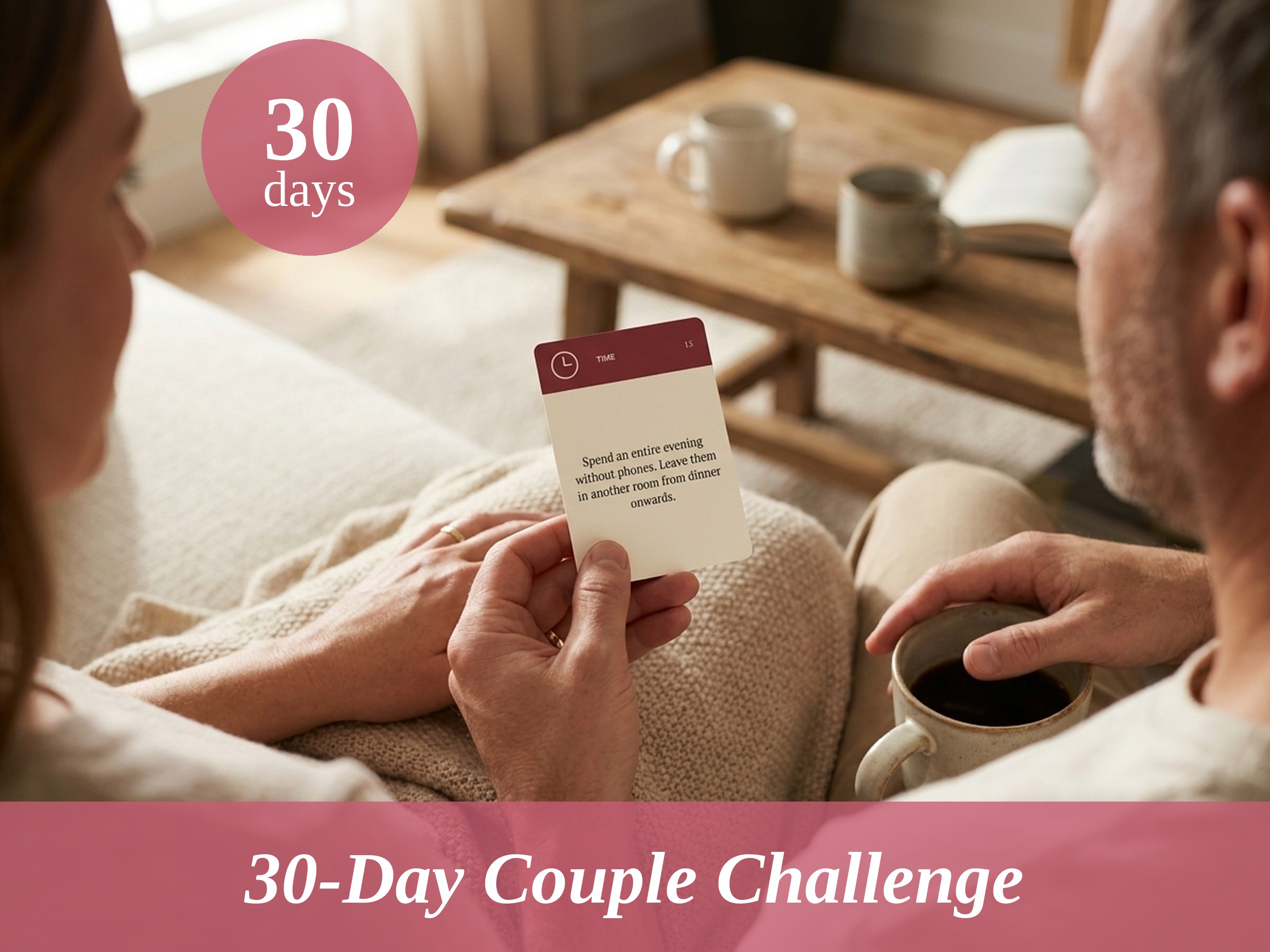
You love each other. You have also, somewhere in the last few years, become very efficient roommates. Not distant — just parallel. The "we should do more together" intention surfaces regularly, then gets crowded out by dinner, dishes, and the streaming queue you barely watch before falling asleep. The problem is not motivation. The problem is that the goal is too abstract.
What works better is structure: a pre-written prompt that removes the decision so the action can just happen. Here is what thirty days of small deliberate rituals can look like — and the research that explains why it works.
The research behind small daily actions
In stable, flourishing relationships, positive interactions outnumber negative ones by roughly five to one — even during conflict. This is the ratio John Gottman identified across four decades of couples research (Gottman & Silver, 1999).
Three findings converge on the same practical conclusion.
Gottman's 5:1 positivity ratio tells us that thriving couples are not tension-free — they simply accumulate far more positive bids than negative ones: a touch, a question, a shared laugh (Gottman & Silver, 1999). Thirty deliberate actions tip that ratio on purpose.
Arthur Aron's self-expansion research adds a second layer: couples who regularly try novel shared activities report meaningfully higher relationship quality than those who stick to routine (Aron et al., 2000). Novelty generates closeness.
The third piece is from UCL's Phillippa Lally: the median time for an action to become automatic is 66 days, not the popular "21 days" (Lally et al., 2010). Thirty days is not the whole habit. It is the seed.

Five phases, thirty days, two minutes each
The structure of the 30-Day Couple Challenge Cards is not random — it follows a progressive arc across five phases, each one building the conditions for the next.
 Five phases. One card per day. The arc is subtle — cards work shuffled, too — but in sequence they tell a story.
| Phase | Days | What it trains | Sample feel |
|---|---|---|---|
| Words | 1–7 | Verbal recognition and gratitude | "Write your partner a short note listing three things you love about them this month." |
| Acts | 8–14 | Small practical gestures, doing-for | "Do one thing on their mental load today without being asked." |
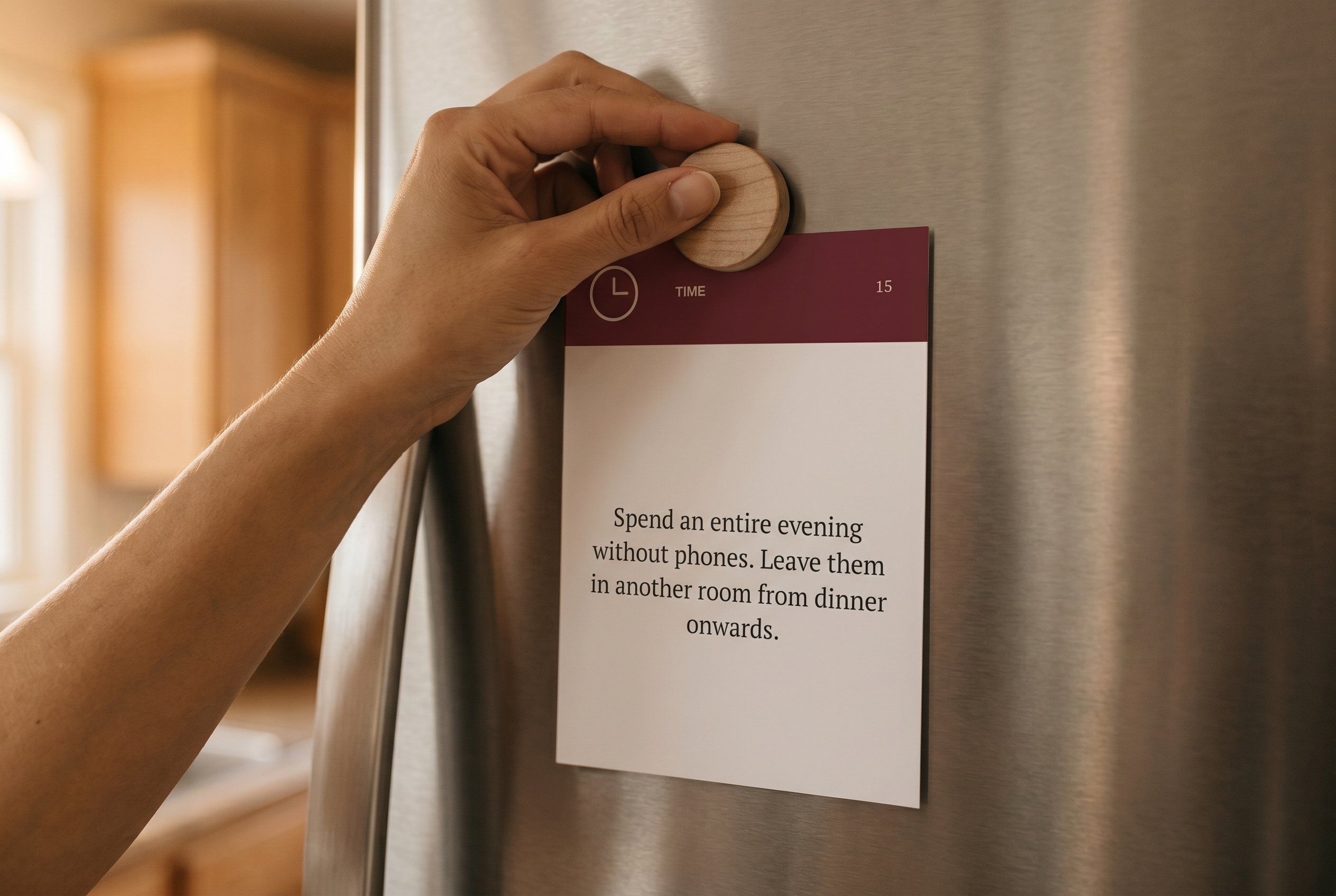
| Time | 15–21 | Presence, undivided attention, touch | "Spend an entire evening without phones. Leave them in another room." |
| Play | 22–28 | Novelty, surprise, flirtation | "Do one thing together you've never done before." |
| Reflect | 29–30 | Looking back, celebrating, deciding what comes next | "Sit together and talk about the month. What surprised you?" |
Words comes first because verbal acknowledgement is the lowest barrier — a note, a text, a spoken compliment. Acts follows: feeling translated into doing. Time trains full presence, which most couples find genuinely hard. Play introduces novelty, Aron's self-expansion driver. Reflect closes the loop and asks: what do you want to keep?
Each card is postcard-size: a colored phase bar at the top, the day number, the challenge, and a time estimate. Pair it with the included progress tracker and you have a visible daily commitment on your fridge.
Why structure beats willpower
"Do more together" is an intention, not a plan. Peter Gollwitzer's research on implementation intentions shows that pre-decided, situationally linked actions are dramatically more likely to happen than open-ended intentions (Gollwitzer, 1999). Motivation is context-dependent. Decision fatigue is real.
A pre-written card solves this at the source. You are not deciding each morning what thoughtful thing to do. The decision is already made. You are only executing it.
The reframe. Structure is not unromantic. Structure is what makes romance actually happen in a busy life, rather than staying perpetually on the "we should" list.
How to actually run the 30 days
 A few principles that make the difference between a card deck you finish and one that sits on the counter.
Pull the card the night before or first thing in the morning. Pin the progress tracker somewhere you both see it. Do not announce the challenge at the start — let your partner notice the small things accumulating. That is half the magic.
Aim for five out of seven days. If you miss one, do not restart — pick up where you left off. Thirty deliberate moments across a month, not a perfect streak. Some couples alternate days; others do every card together. Any rhythm that fits is the right one.


Start with Words
Days 1–7 are designed to be easy — a note, a text, a spoken compliment. Low barrier, visible results. The arc works if you begin here.

Use the tracker
The progress tracker page is designed for the fridge. Each check-off circle is a small visual reward that reinforces the habit loop.

Thirty days is a seed
UCL habit research puts the median habit-formation timeline at 66 days. You are planting something in thirty — not finishing it. Keep one habit from each phase when the month is up.
Related reading
- 5 Questions to Ask Instead of "How Was Your Day?" — the daily check-in version
- The Science of Family Dinners — a different ritual for a different table
Sources
- Gottman, J. M., & Silver, N. The Seven Principles for Making Marriage Work. Crown Publishers (1999).
- Aron, A., Norman, C. C., Aron, E. N., McKenna, C., & Heyman, R. E. Couples' shared participation in novel and arousing activities and experienced relationship quality. Journal of Personality and Social Psychology, 78(2), 273–284 (2000).
- Lally, P., van Jaarsveld, C. H. M., Potts, H. W. W., & Wardle, J. How are habits formed: Modelling habit formation in the real world. European Journal of Social Psychology, 40(6), 998–1009 (2010).
- Gollwitzer, P. M. Implementation intentions: Strong effects of simple plans. American Psychologist, 54(7), 493–503 (1999).