It happens fast. Everyone is at the table, food is warm, and someone asks the question. How was school? Fine. Anything interesting happen today? Not really. Forks move. Someone reaches for a phone. The dinner you planned is technically happening, but the conversation isn't.
Most parents recognise this loop and don't have a clear replacement for it. This article has two parts: the research that explains why shared dinners are worth the effort, and twenty questions that actually open a conversation rather than close one.
Teens who share family dinners regularly — roughly five times a week — consistently show lower rates of substance use, higher self-esteem, and stronger academic outcomes than peers who rarely eat together, according to research from Columbia University's National Center on Addiction and Substance Abuse (CASA) tracked across multiple annual reports.
The research says it matters — more than most parents realise
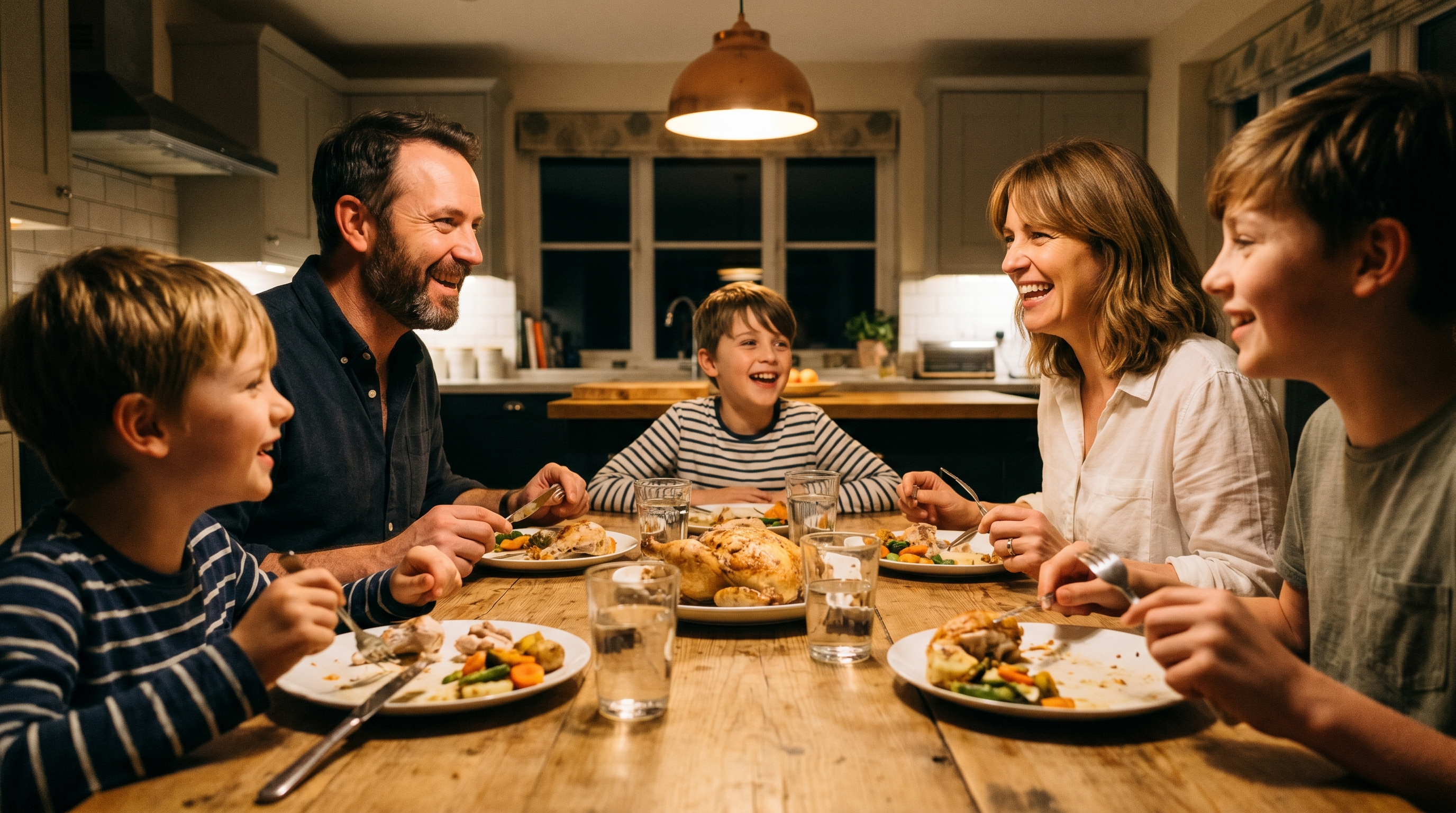
Columbia University's National Center on Addiction and Substance Abuse has tracked the link between family dinner frequency and adolescent outcomes across more than a decade of annual research. Teens who eat with their families regularly are consistently less likely to use drugs or alcohol, more likely to report strong relationships with parents, and more likely to perform better academically. The Harvard Family Dinner Project, which synthesises research across nutrition, developmental psychology, and family systems, adds a third dimension: language. Children who participate in regular dinner conversation develop vocabulary and narrative skill at a measurably higher rate than those who don't — not because dinner is an educational exercise, but because it's one of the few daily contexts where multi-generational, unscripted conversation happens naturally.
The protective effect is not about the food. It's about the ritual — showing up, together, on a predictable schedule.
Why "how was school?" stops working
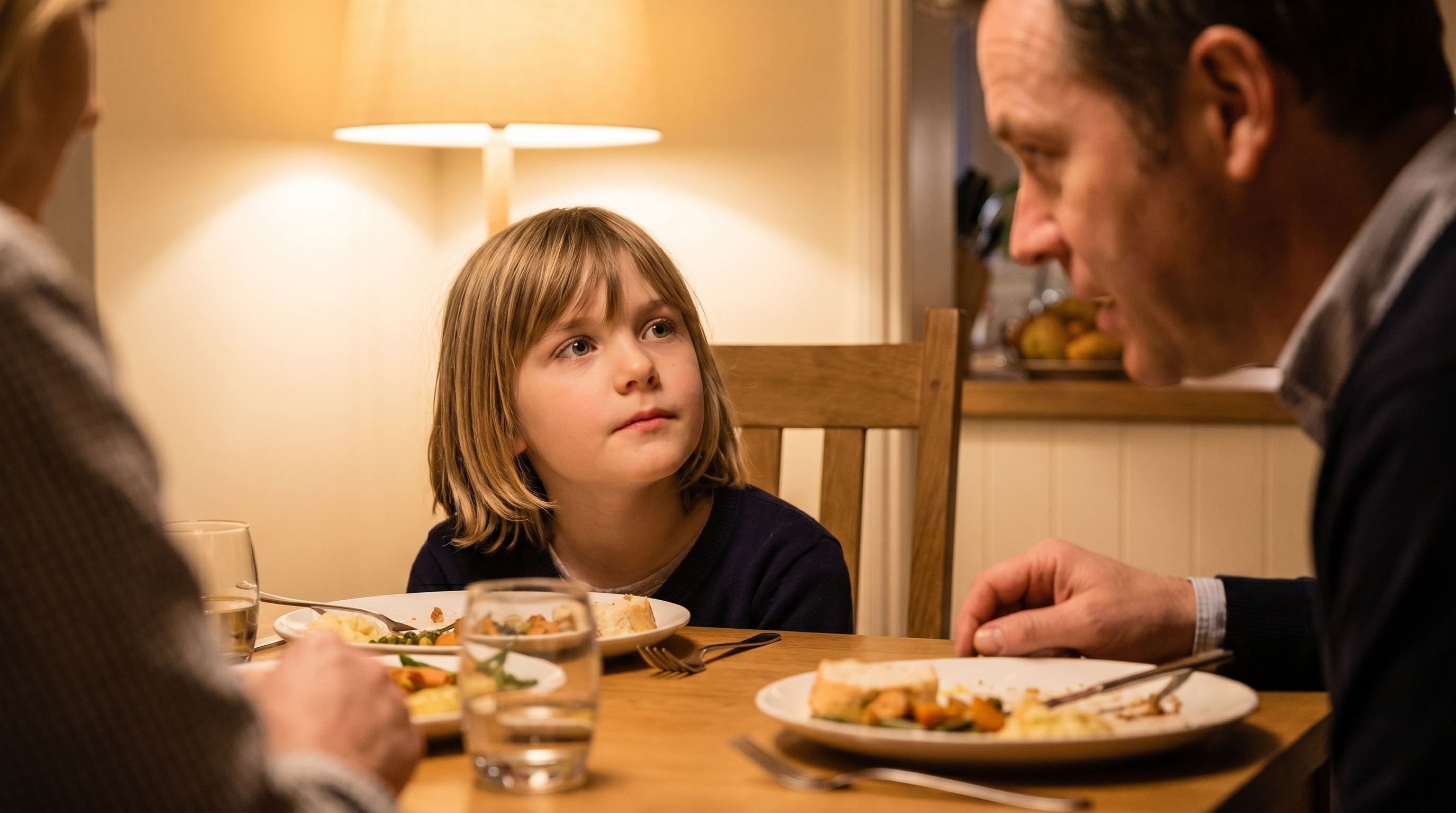
Closed questions are conversational exit ramps. How was school? offers two routes out: "fine" and "bad." The brain's first response to a question it has answered a thousand times is not reflection — it's retrieval. Kids and teenagers, especially, have a finely tuned instinct for deflecting low-stakes, general questions with low-effort answers.
Bruce Feiler, who spent two years studying thriving families for The Secrets of Happy Families (2013), found that the quality of family conversation depended far more on question design than on the amount of time families spent together. Open, specific, low-stakes questions — ones that invite opinion, imagination, or memory rather than a factual report — reliably produced longer, warmer exchanges. Susan David, a Harvard Medical School psychologist, makes a similar point about emotional conversations: questions that ask "what" rather than "did" or "was" tend to unlock more honest responses.
The practical upshot is small: replace one closed question with one open one, and the texture of dinner changes.
| Closed | Open alternative |
|---|---|
| How was school? | What's one thing you noticed today that nobody else probably noticed? |
| Did anything happen? | What made today feel fast or slow? |
| Are you okay? | What's something from today you want to remember a year from now? |
20 questions that actually work
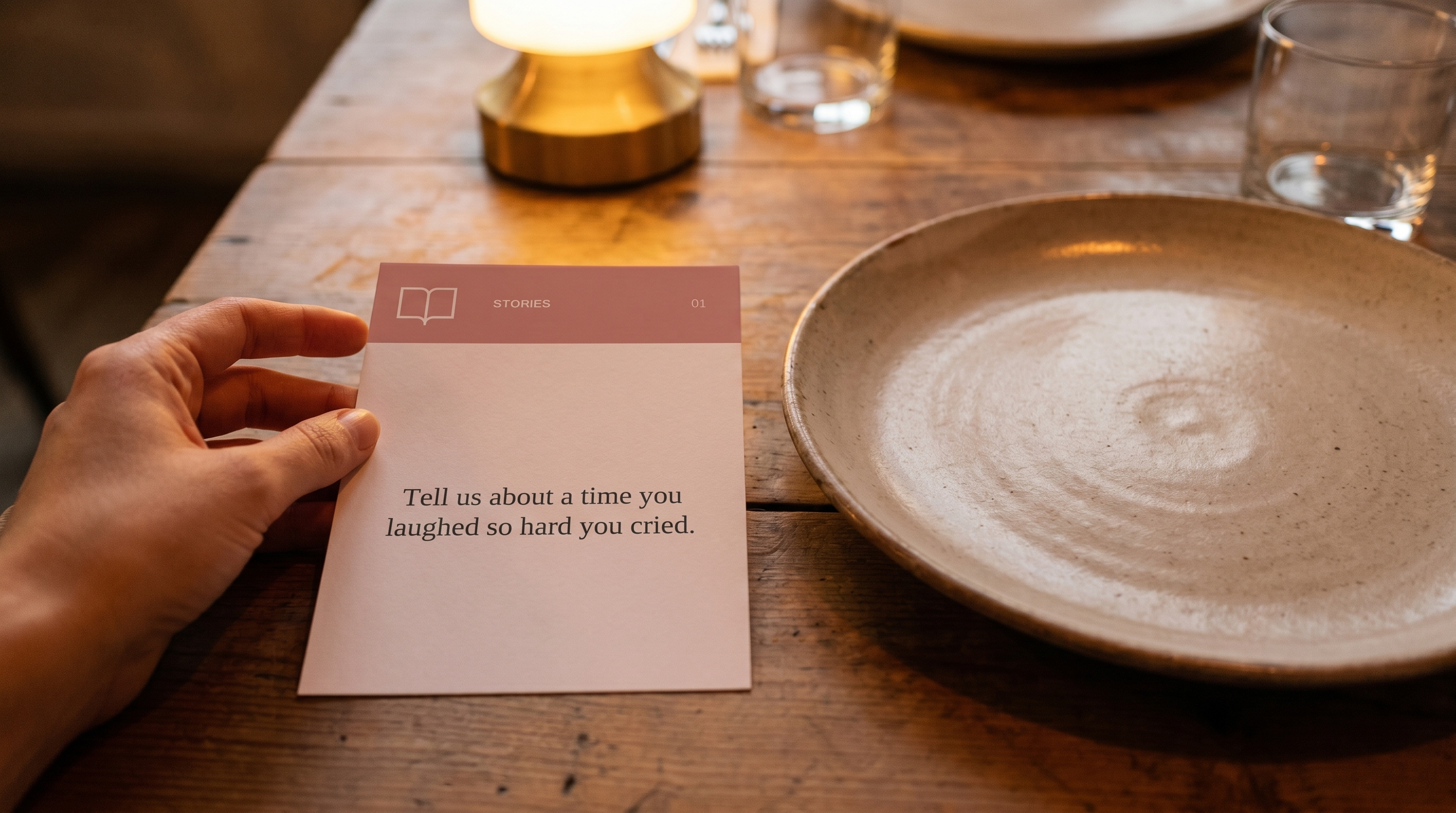
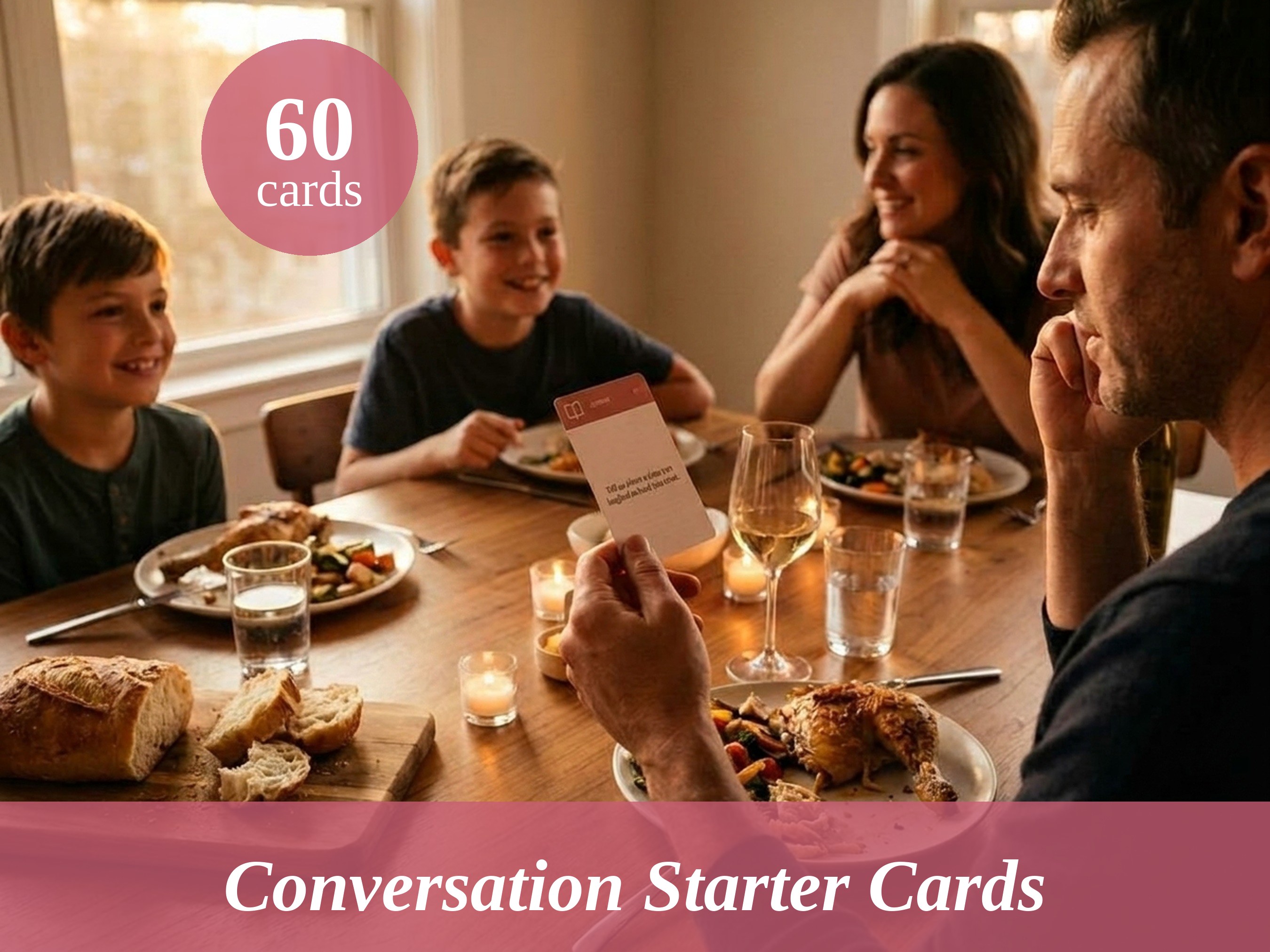
Product 58's deck organises 60 cards into four suits — Stories, Opinions, Imagining, and Questions — because each mood opens a different kind of conversation. The twenty below follow the same logic.
Stories — invite memory and narrative:
- Tell us about a moment this week you almost didn't notice but actually kind of mattered.
- What's something someone said to you today that stuck?
- Describe your day as if it were a movie title.
- What's a moment from this month you want to remember in five years?
- Tell us about a time recently you changed your mind about something.
Opinions — invite position and gentle debate: 6. If you could change one rule in this family, what would it be and why? 7. What's one thing you think adults get wrong about kids your age? 8. What would you do differently if you were in charge of school lunch? 9. What's something you think is overrated? What's something underrated? 10. What would make this city a better place to grow up?
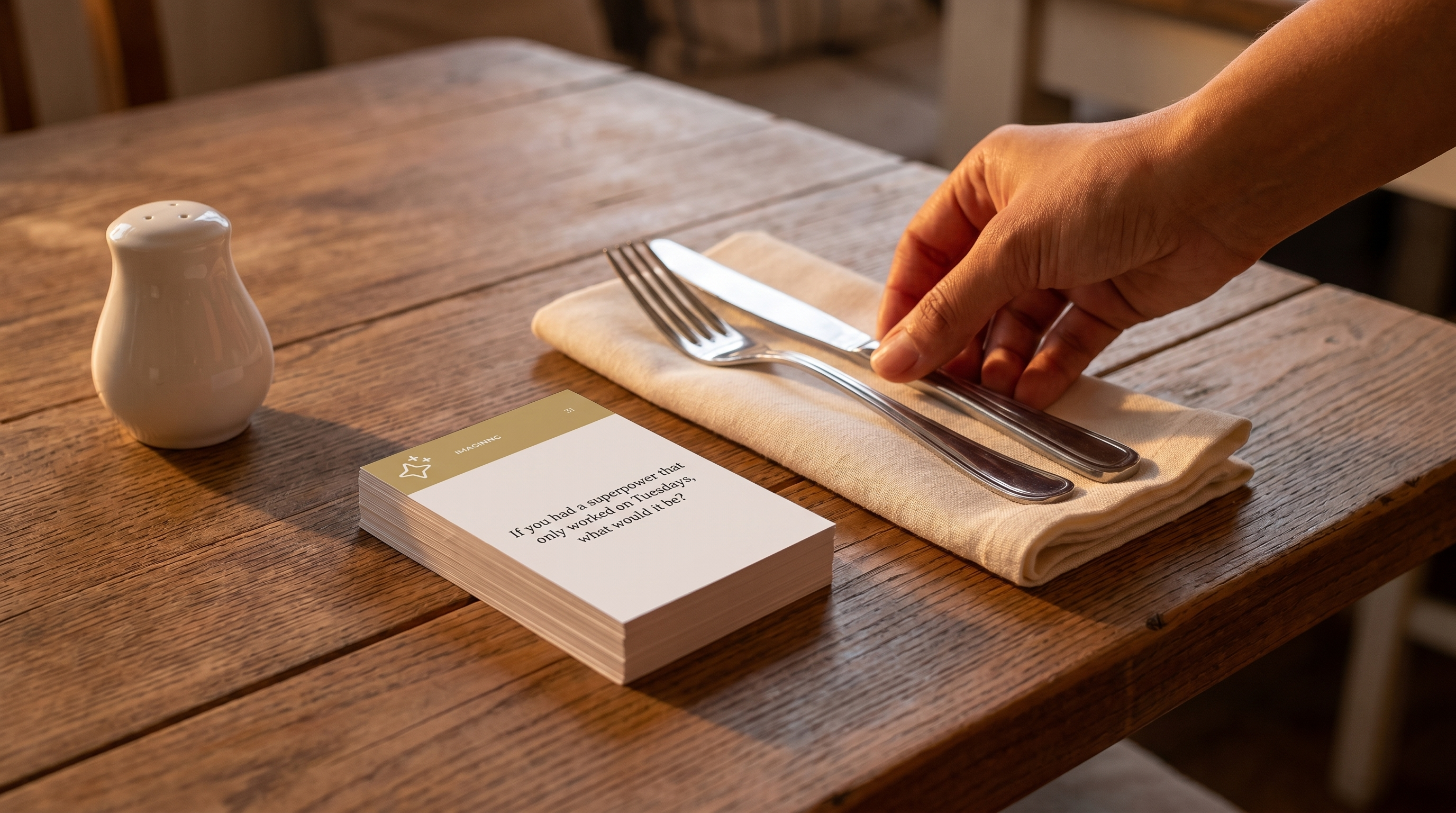
Imagining — lower the bar, especially for tired kids and reluctant talkers: 11. If you could swap lives with any animal for exactly 24 hours, which one and why? 12. What superpower would you want, but it only works on Wednesdays? 13. If our family had a theme song, what would it be? 14. You get to design one new holiday — what happens on that day? 15. If dinner could teleport us anywhere tonight, where would you pick?
Questions — honest, two-way, goes around the table: 16. What's something you've been wondering about lately? 17. What made your day easier, even a tiny bit? 18. What's one thing you'd want someone at this table to know about you right now? 19. What's something you're looking forward to that's coming up? 20. What's one question you want to ask someone at this table tonight?
If you want a full set of sixty already sorted into categories, the Family Dinner Conversation Starter Cards are designed to keep one suit in rotation per week — so questions feel fresh rather than repeated.
 One category per week. Shuffle within the suit. Let the same question surface again in a different month — people answer differently when the season changes.
Small moves that make dinner stick
The research on family rituals (William Doherty, The Intentional Family, 1997) consistently shows that shared meals need structure to survive busy weeks. Not structure as in rules — structure as in predictability.
Three things that help:
- Anchor it to a day. Even one protected night — Sunday dinner, Friday tacos — gives the habit somewhere to live.
- One phone-free zone. A basket by the door, a drawer, a simple agreement. The phone's absence changes the texture of dinner faster than any question deck.
- Start with something silly. An absurd imagining question lowers the activation energy for everyone at the table, including adults. Funny first, meaningful after — that sequence works.
Related reading
- 5 Questions to Ask Instead of "How Was Your Day?" — the same idea, applied to your partner
- Montessori-Inspired Toddler Activities at Home — screen-free activities for the 12–36m years
Sources
- Columbia University, National Center on Addiction and Substance Abuse (CASA). The Importance of Family Dinners (annual report series). centeronaddiction.org.
- The Family Dinner Project, Harvard University. Research on Family Dinners. thefamilydinnerproject.org.
- Feiler, B. The Secrets of Happy Families: Improve Your Mornings, Tell Your Family History, Fight Smarter, Go Out and Play, and Much More. William Morrow (2013).
- David, S. Emotional Agility: Get Unstuck, Embrace Change, and Thrive in Work and Life. Avery (2016).
- Doherty, W. J. The Intentional Family: Simple Rituals to Strengthen Family Ties. Addison-Wesley (1997).