Date night is lovely. It is also easy to miss when someone is overtired, the baby monitor is on, and the sink is full. Connection usually does not disappear because we stopped caring — it gets crowded out by ordinary life.
Core insight. In John Gottman's research, the quality of daily "stress-reducing conversation" is a stronger predictor of long-term relationship satisfaction than grand gestures or planned nights out (Gottman, 1999). A better everyday question can do more for closeness than waiting for the perfect evening.
Stable couples turn toward each other's small bids for connection roughly three times more often than unstable couples — one of the most consistent findings across Gottman's four-decade research (Gottman Institute).
The small check-in is not a small thing

"How was your day?" is not a bad question — it is a perfectly normal starting point. It just tends to be too broad when our brains are fried. Open-ended prompts give the other person a clearer door to walk through, which usually invites more detail and emotion than a one-word reply (Gottman, 1999; general consensus).
Five questions that actually open the door

Try one of these tonight — not all five, just one:
"What felt heavier than it needed to today?" — invites specificity without jumping to fixing.
"What gave you even a tiny spark today?" — helps tired brains notice good moments they missed.
"Where did you feel most stretched or pulled today?" — gets specific fast, which makes empathy easier.
"What is still sitting with you tonight, honestly?" — a gentle way to surface the thing lingering underneath.
"What would help you feel cared for tonight?" — turns connection into something practical: ten minutes alone, tea, a hug, backup.
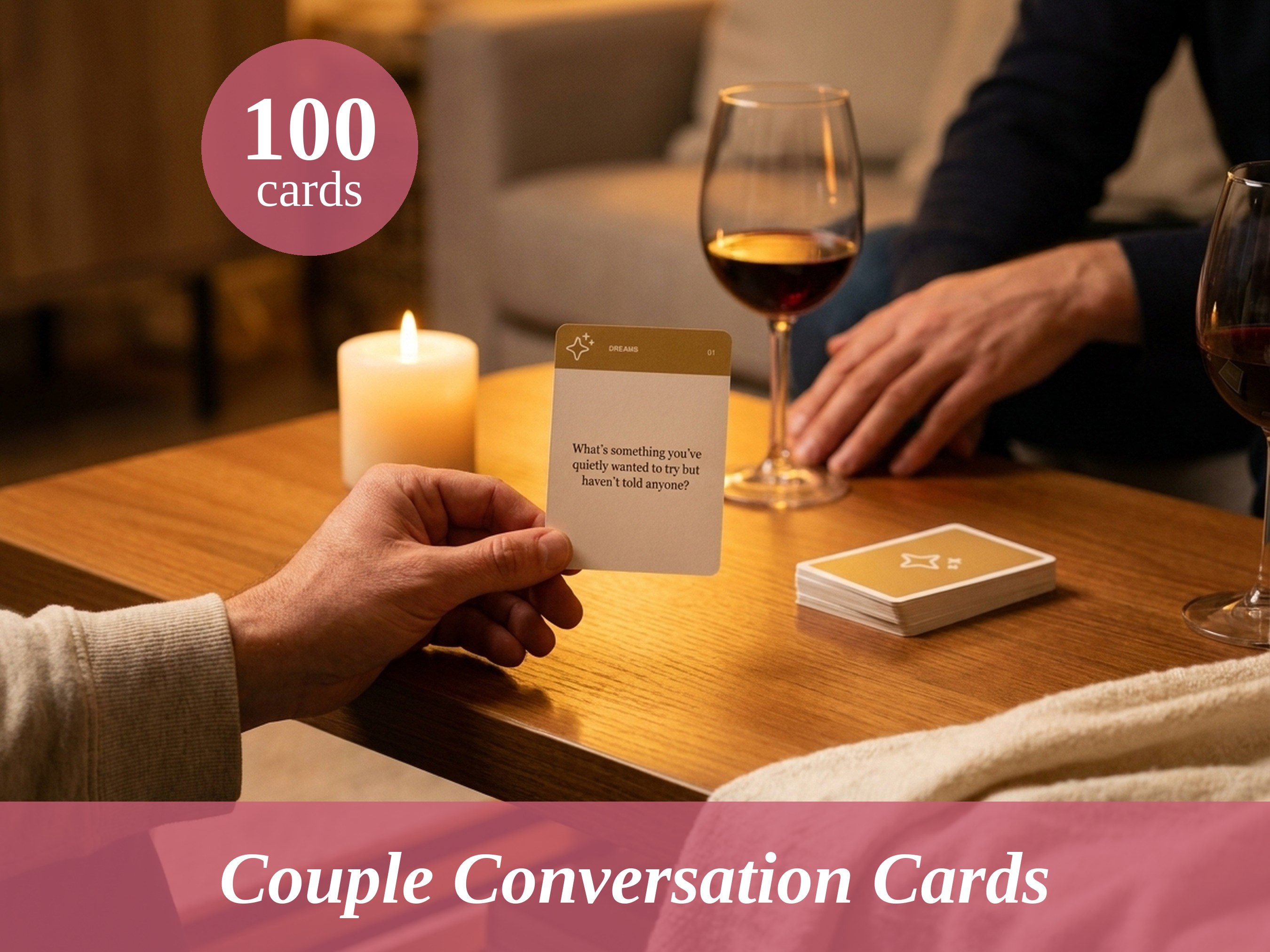
If you want a full deck of evening check-in prompts ready to use, our 100-card couples conversation deck was designed exactly for this — five suits covering dreams, memories, desires, challenges, and the future.
The answer matters less than how we receive it

Once the question lands, the goal is not to fix everything before bedtime. Gottman describes stress-reducing conversation as a chance to listen, take your partner's side, and keep outside stress from turning into inside conflict (Gottman, 1999).
A simple "tell me more," "that makes sense," or "do you want comfort or ideas?" often does more than quick advice.
Ways to make it stick

Keep it short
One real question and one follow-up, not a full nightly recap.

Protect five minutes
A brief phone-free check-in feels different when we are fully there.

Trade turns
Let each person ask once so it does not become an interview.
What you can skip. Interview mode, multitasking through the answer, and the pressure to finish the whole conversation in one sitting. This is not a nightly performance — it is a small ritual for staying in reach of each other.
A gentle takeaway
One better question will not solve everything, and it does not have to. But it can turn a routine "How was your day?" into a real moment of being seen — which is often how closeness grows in busy seasons. If you want an easy prompt to keep by the coffee maker, our Conversation Starter Cards were made for nights like this.
Related reading
- The 30-Day Couple Challenge — when small daily rituals become a month-long structure
- The Science of Family Dinners — the same principles, applied to the dinner table
Sources
- Gottman, J. M., & Silver, N. The Seven Principles for Making Marriage Work. (1999). Crown Publishers.
- Gottman, J. M., & Gottman, J. S. The Science of Couples and Family Therapy. (2018). W. W. Norton & Company. — longitudinal research on bids for connection and relationship stability.