You don't need a whitewashed classroom or a shelf full of wooden insets. The core idea behind Montessori-inspired play is simpler than the Instagram aesthetic suggests: give a toddler one clear concept, a task with a built-in way to self-correct, and enough space to work it out alone. The furniture is optional. The kitchen table is not.
The five activities below cover the main developmental windows between 12 and 36 months — vocabulary, visual discrimination, color and shape categorisation, and early number sense. Each one takes roughly 15 minutes to set up and run. Each connects to a printable you can use tonight.
The typical uninterrupted concentration span a well-presented Montessori activity can draw from a 2–3-year-old — a window that grows with practice (Lillard, A.S. Montessori: The Science Behind the Genius, 2017).
First words — 12 to 24 months

The 1–3-year window is when vocabulary climbs fastest — roughly one new word a day at peak velocity, according to the American Speech-Language-Hearing Association. Montessori's three-part lesson (name it, recognise it, recall it) is a precise match: you say "apple," the child looks, and eventually the word surfaces unprompted.
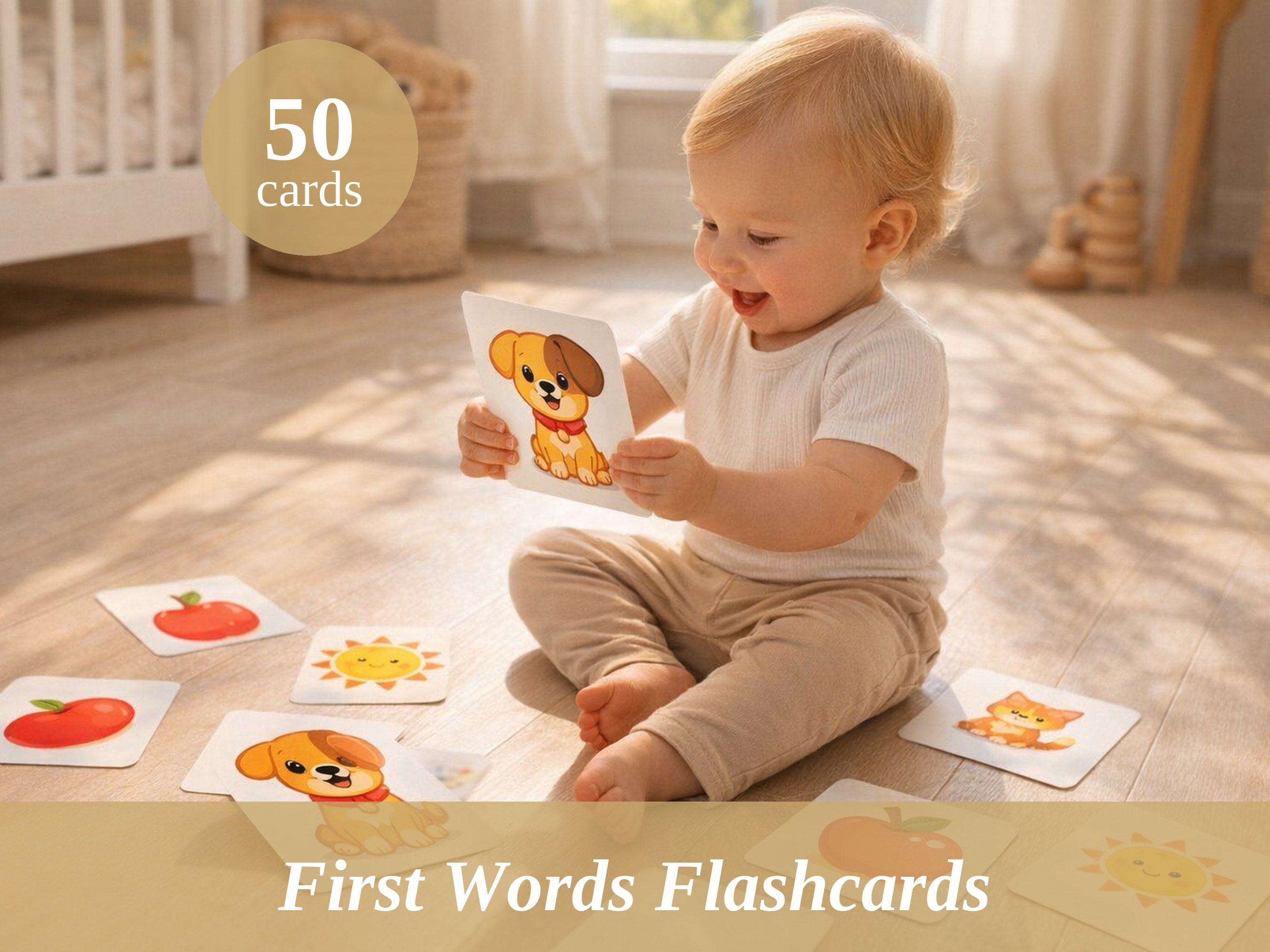
The practical version at home: pull out 5–10 cards from the First Words Flashcards deck, place them one at a time, name the picture, and pause. No drilling, no repetition demands. The ritual takes ten minutes and works just as well during meal prep as it does in a dedicated sit-down session.
 50 picture-word cards across 5 themed groups — animals, food, home, body, and the outside world.
Shadow matching — 2 to 3 years

Shadow matching isolates a single perceptual challenge: recognise a shape from its outline alone, stripped of colour and detail. That's not a party trick — it's the visual discrimination skill reading researchers point to as a pre-literacy marker (National Reading Panel, 2000). Montessori calls this sensorial pair-matching: the child compares two things and finds the connection without any adult scoring the result.
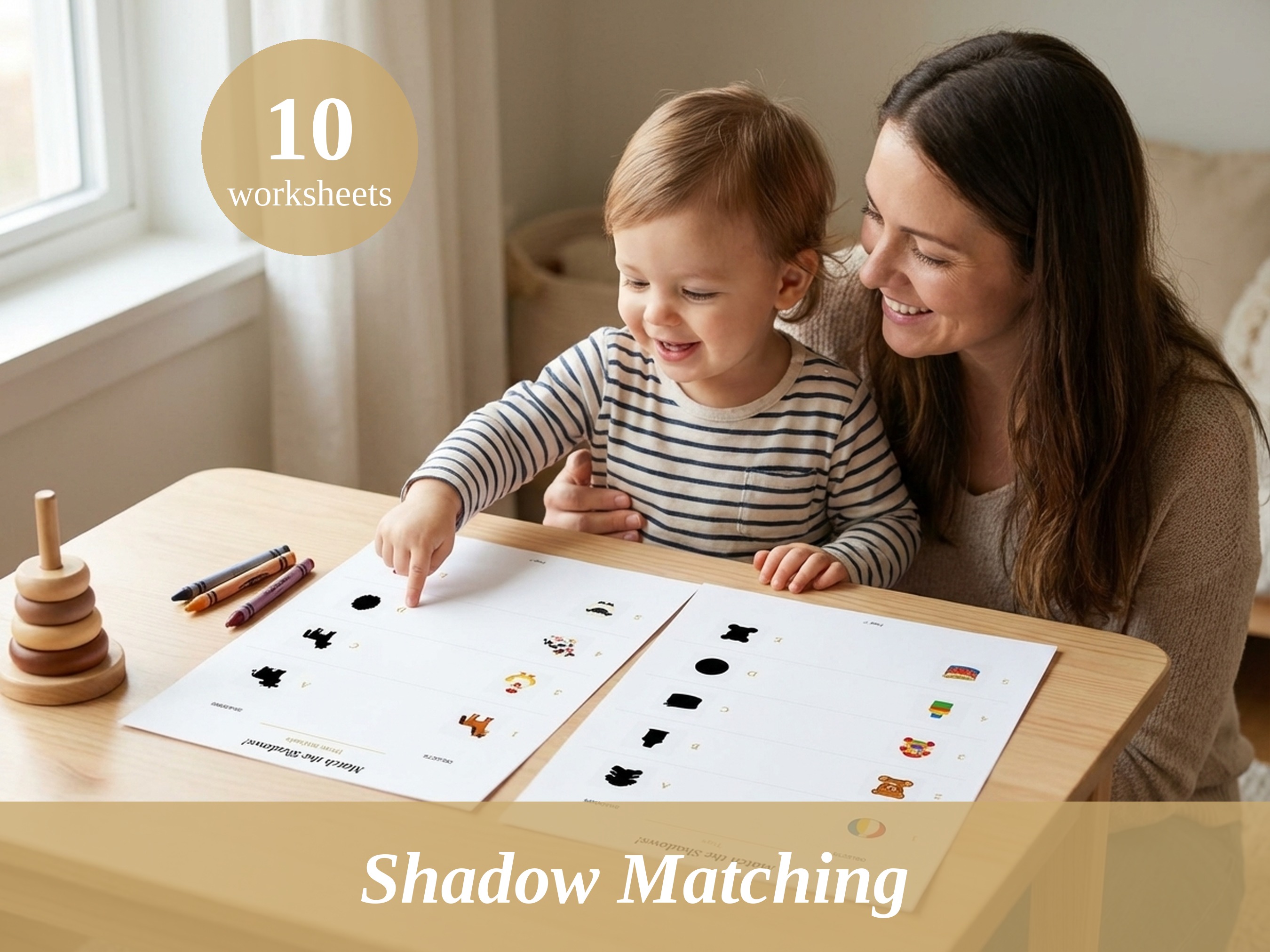
Set up one or two worksheets from the Shadow Matching Activity Pack on the floor or a low table. Offer a crayon or counter — the child draws lines or places objects to make matches. Laminate the sheets and you can reset them in seconds. You might notice a toddler return to the same page unprompted; that's the self-correction loop doing its work.
Color sorting — 18 months to 3 years
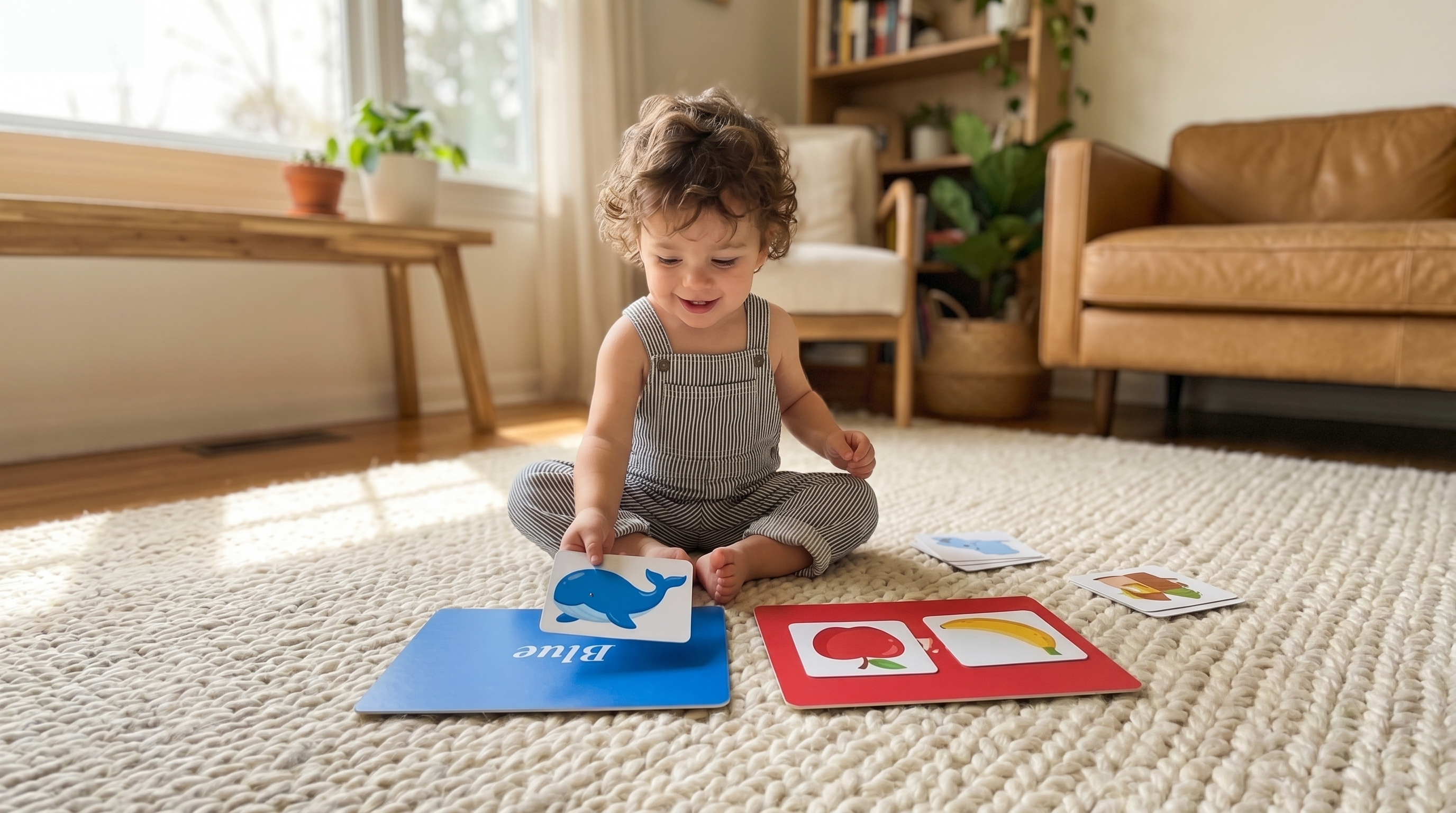
Montessori's principle of isolation of variable is the reason color sorting works so efficiently: when the only difference between cards is color (same object shapes, same size), the toddler can focus on exactly one concept. No competing variables.
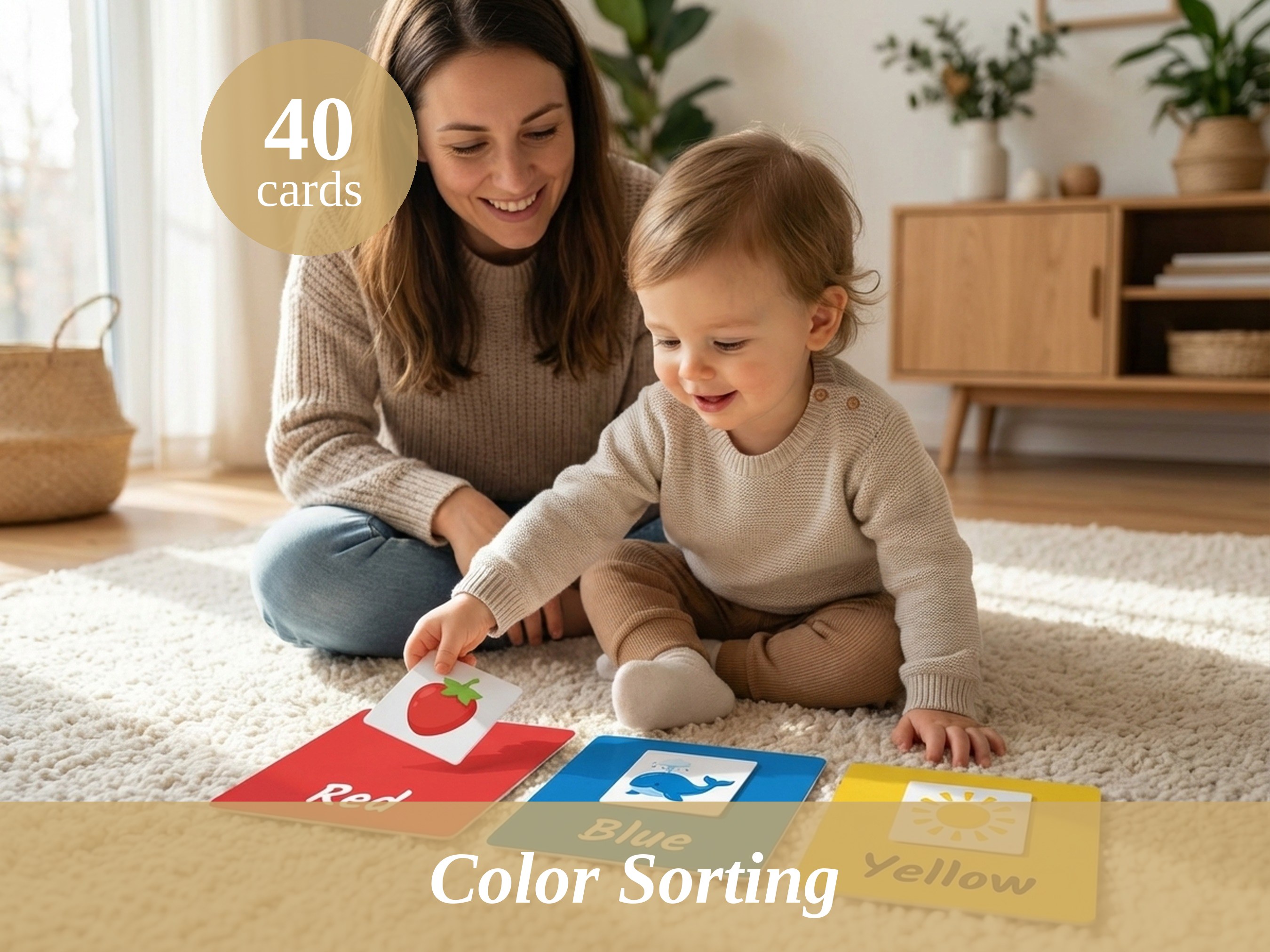
Lay out two or three mats from the Color Sorting Activity, mix a stack of cards face-down, and step back. The game teaches itself. A 20-month-old will mostly sort by trial and error; a 30-month-old will usually scan and place deliberately — you're watching categorisation develop in real time. Extend the game later by hunting real objects from around the room to match each mat.
Shape sorting — 18 months to 3 years
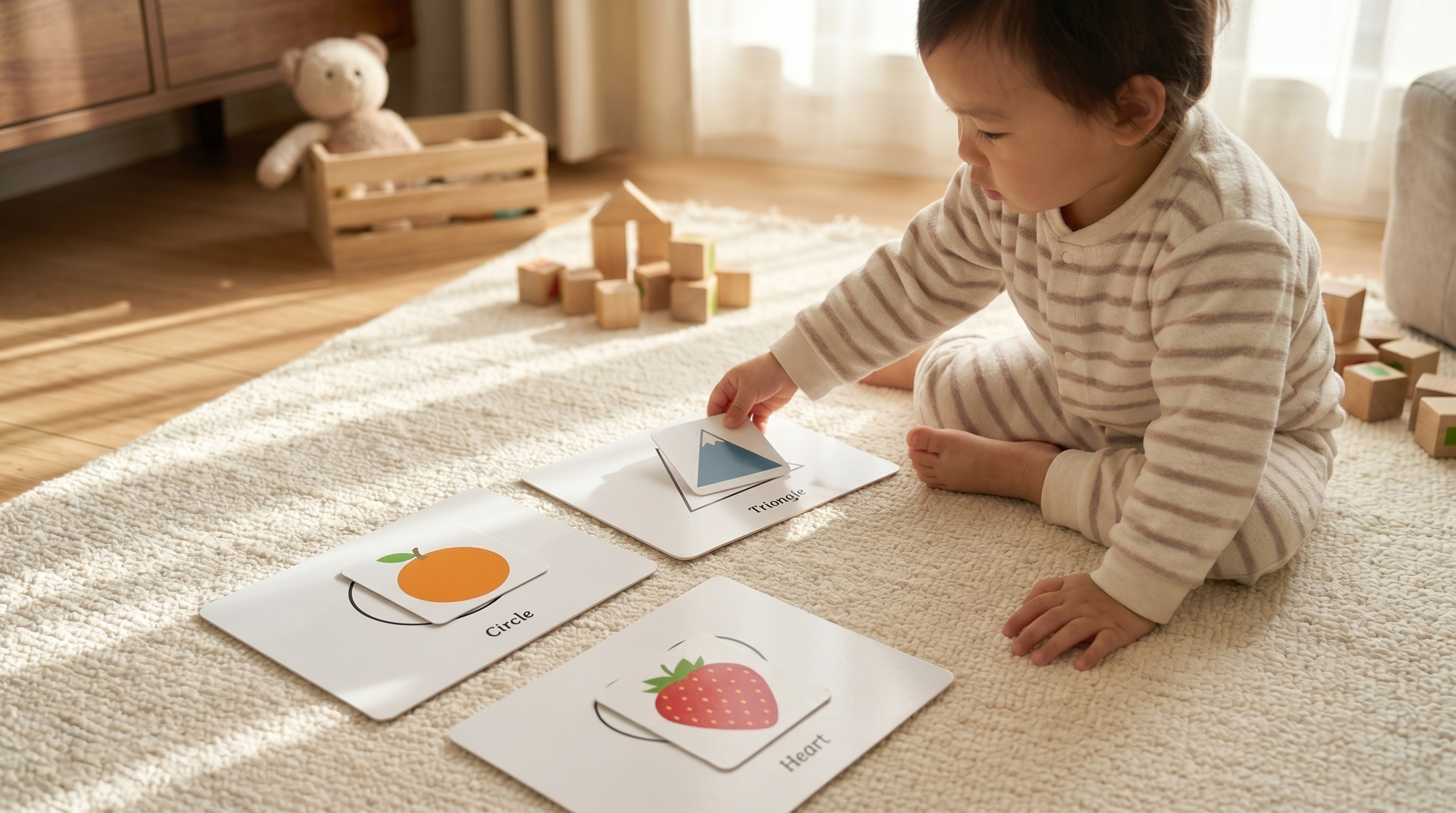
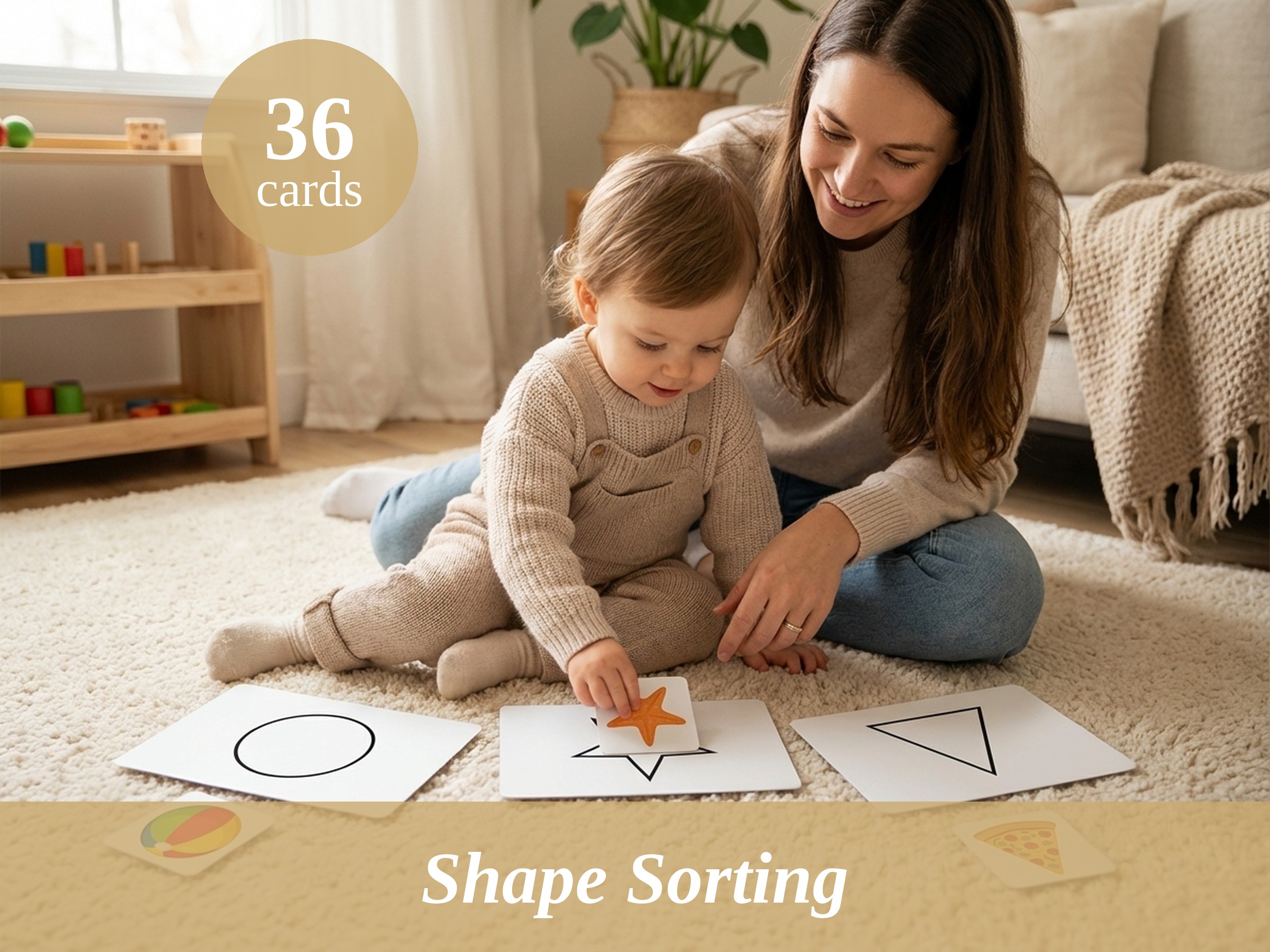
Shape recognition at this age is genuinely geometric: toddlers are building the spatial vocabulary that will later support measurement, mapping, and early algebra. The Shape Sorting Activity uses the same isolation logic as the color pack — object cards in neutral tones so the shape variable stands alone. A clock goes on the circle mat; a pizza slice on the triangle.
Start with three shapes (circle, square, triangle) and add more as confidence grows. The extension game writes itself: find three rectangles in this room sends a toddler on a 10-minute hunt through the house. The printable just sets the categories; the learning happens in the everyday environment Montessori called the prepared environment — which is also just your home.
Counting 1–10 — 2 to 3 years
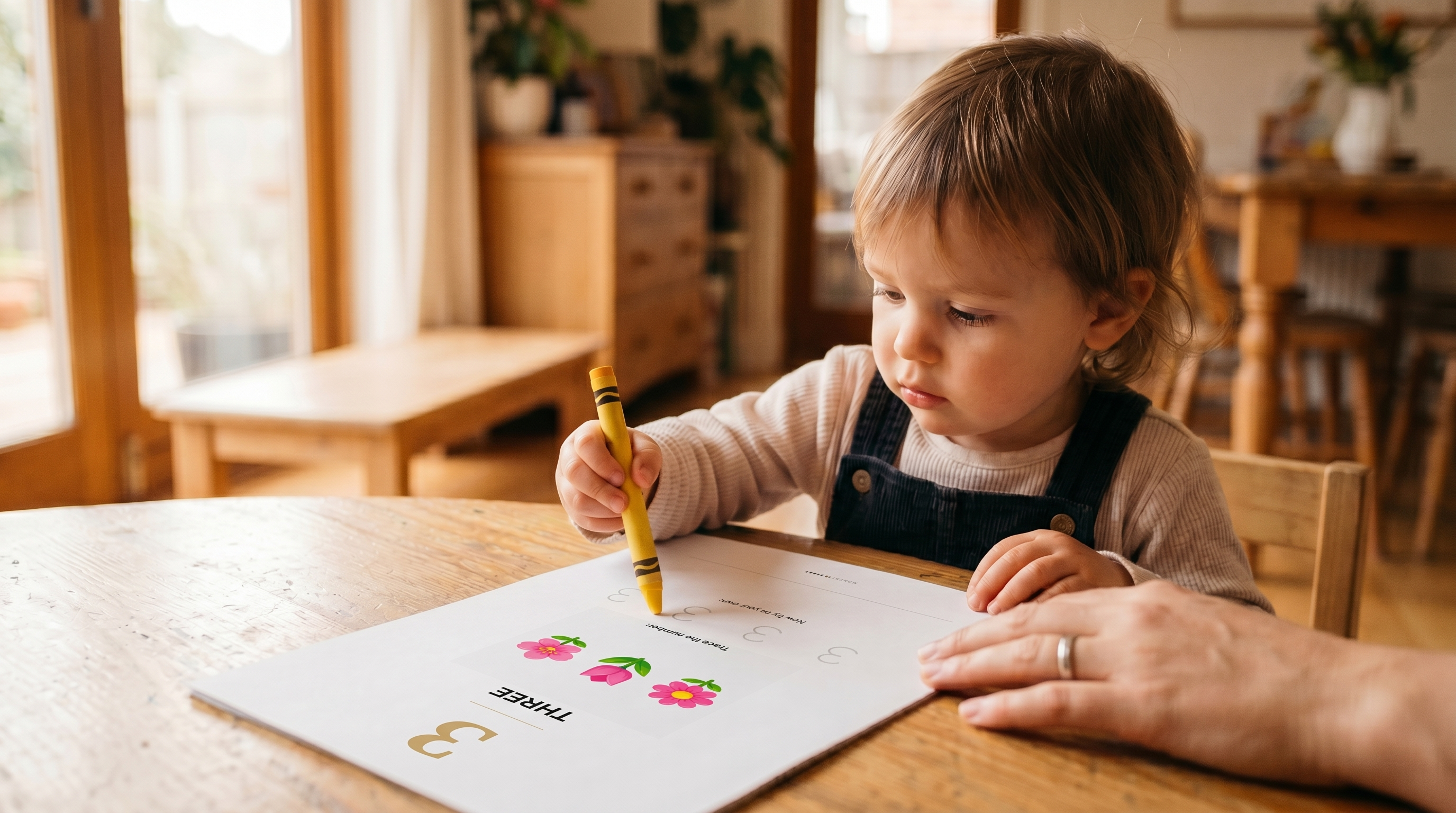
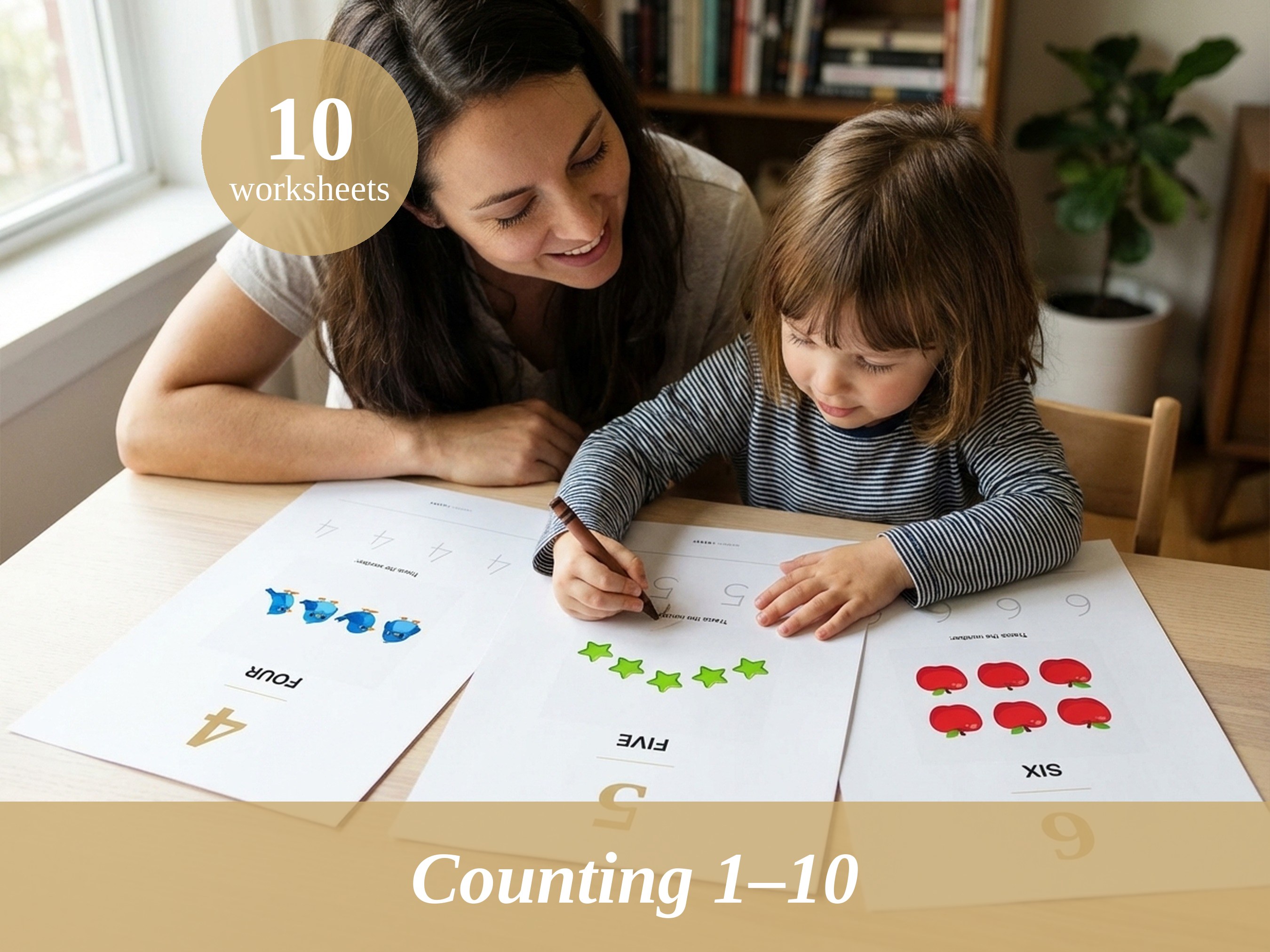
Early number sense is built from one-to-one correspondence: this many things equals this symbol. The Counting 1–10 Activity Set pairs a counting illustration with a dotted number trace on the same page, so the toddler connects the spoken word, the quantity, and the written numeral in a single session — the concrete-to-abstract sequence Montessori considered foundational for all later maths.
One worksheet per sitting, 10–15 minutes, fat pencil or dry-erase marker. Laminate the pages and the set becomes an indefinitely reusable resource. The goal isn't a perfect trace — it's the link between four apples and the squiggle that means four.
Five activities, one table
First Words
Ages 12–24m. Vocabulary & object–word pairing. One card at a time, pause after each word.
Shadow Matching
Ages 2–3y. Visual discrimination, pre-reading. One or two worksheets; crayon or counter to match.
Color Sorting
Ages 18m–3y. Categorisation, fine motor. Two or three mats to start; step back and let them sort.
Shape Sorting
Ages 18m–3y. Geometry, fine motor. Begin with circle, square, triangle. Hunt shapes in the room to extend.
Counting 1–10
Ages 2–3y. Number sense, tracing, fine motor. One worksheet per session; laminate for daily reuse.
| Activity | Age window | Skill built | Printable |
|---|---|---|---|
| First Words | 12–24 months | Vocabulary, object–word pairing | First Words Flashcards |
| Shadow Matching | 2–3 years | Visual discrimination, pre-reading | Shadow Matching Activity Pack |
| Color Sorting | 18 months–3 years | Categorisation, fine motor | Color Sorting Activity |
| Shape Sorting | 18 months–3 years | Geometry, spatial reasoning, fine motor | Shape Sorting Activity |
| Counting 1–10 | 2–3 years | Number sense, tracing, fine motor | Counting 1–10 Activity Set |
You don't need 30 minutes or a tidy room. You need one printed sheet, a low surface, and the restraint to sit back and let them work. That last part — resisting the urge to help — is, arguably, the most Montessori thing on this list.
Related reading
- Newborn Vision by Age: What Your Baby Actually Sees — the first year, visually
- The Science of Family Dinners — when your toddler starts joining the family conversation
Sources
- American Speech-Language-Hearing Association. Late Language Emergence. asha.org.
- Lillard, A. S. Montessori: The Science Behind the Genius (3rd ed.). Oxford University Press (2017).
- National Reading Panel. Teaching Children to Read: An Evidence-Based Assessment of the Scientific Research Literature. National Institute of Child Health and Human Development (2000). nichd.nih.gov.
- Duncan, G. J., et al. School readiness and later achievement. Developmental Psychology, 43(6), 1428–1446 (2007). doi.org.
- Clements, D. H., & Sarama, J. Early childhood mathematics education research: Learning trajectories for young children. Routledge (2009).