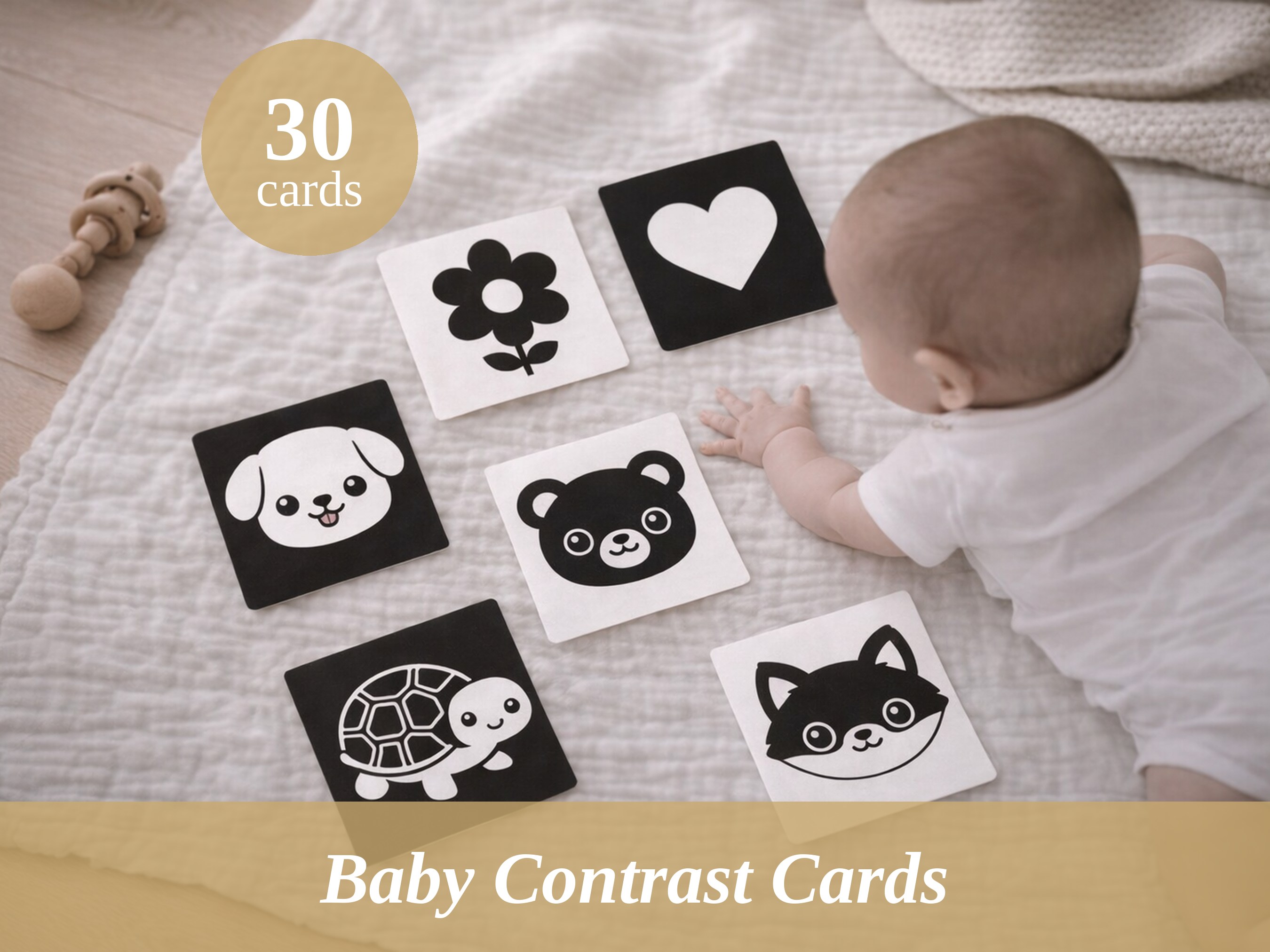
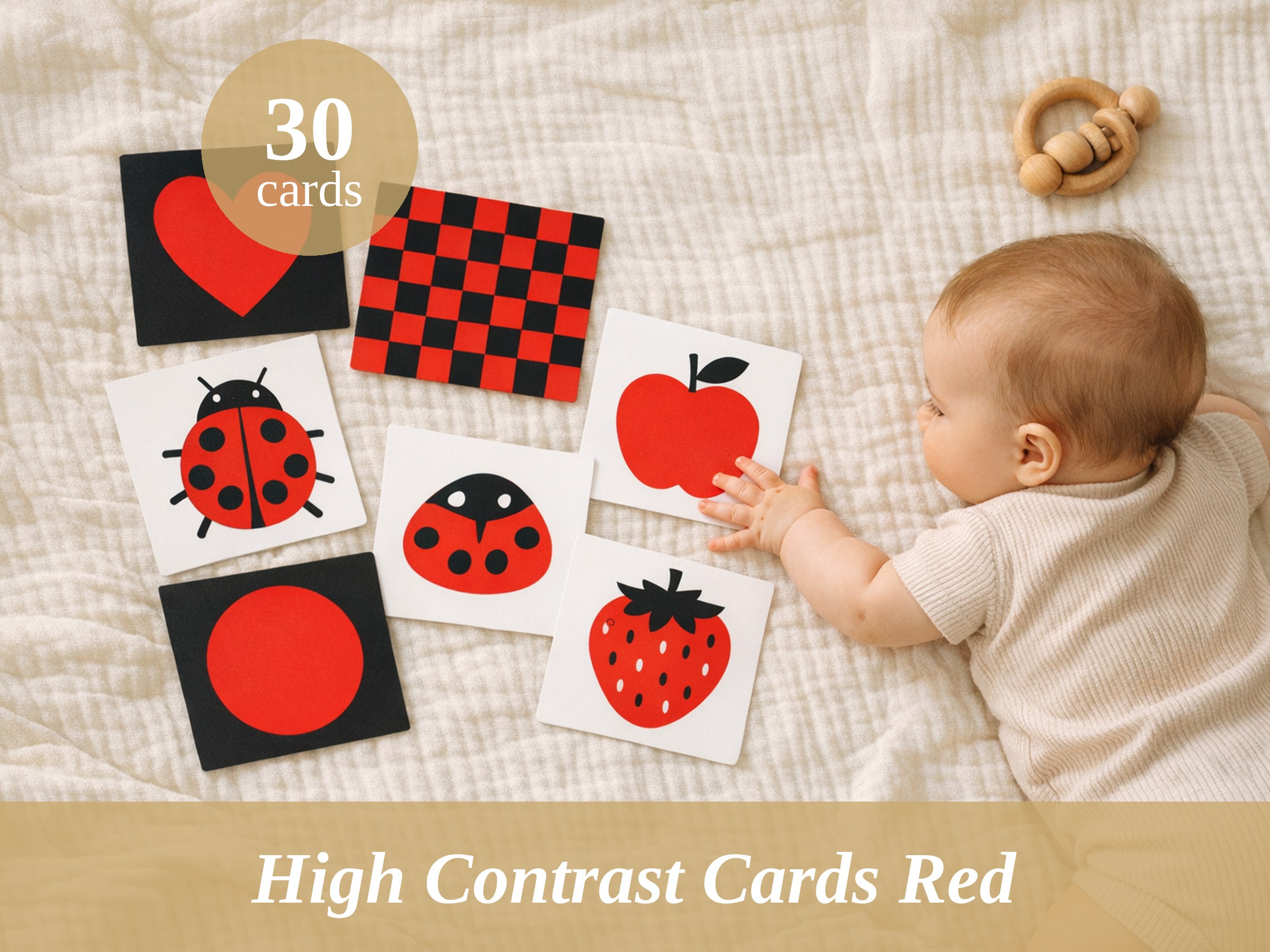
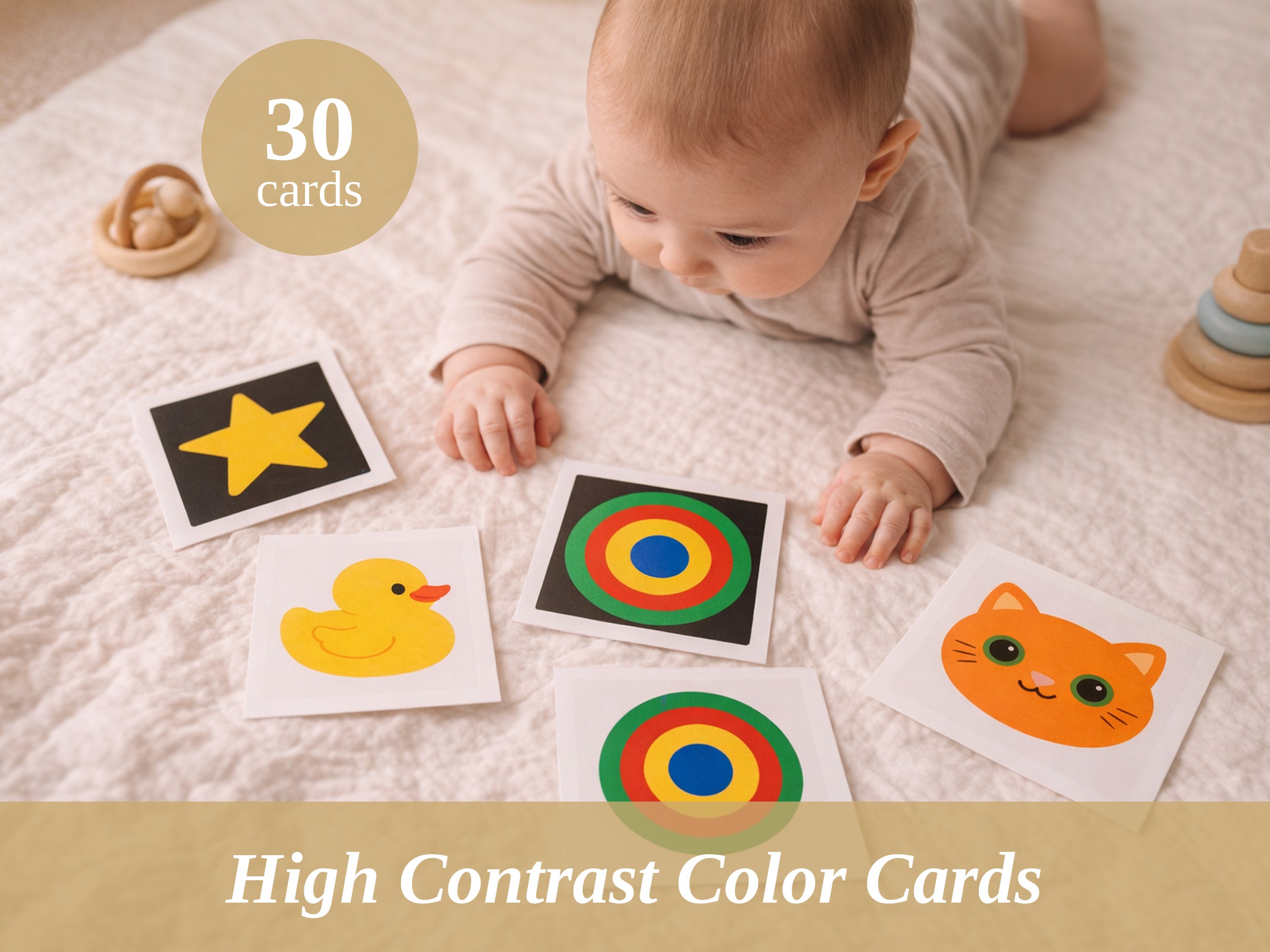
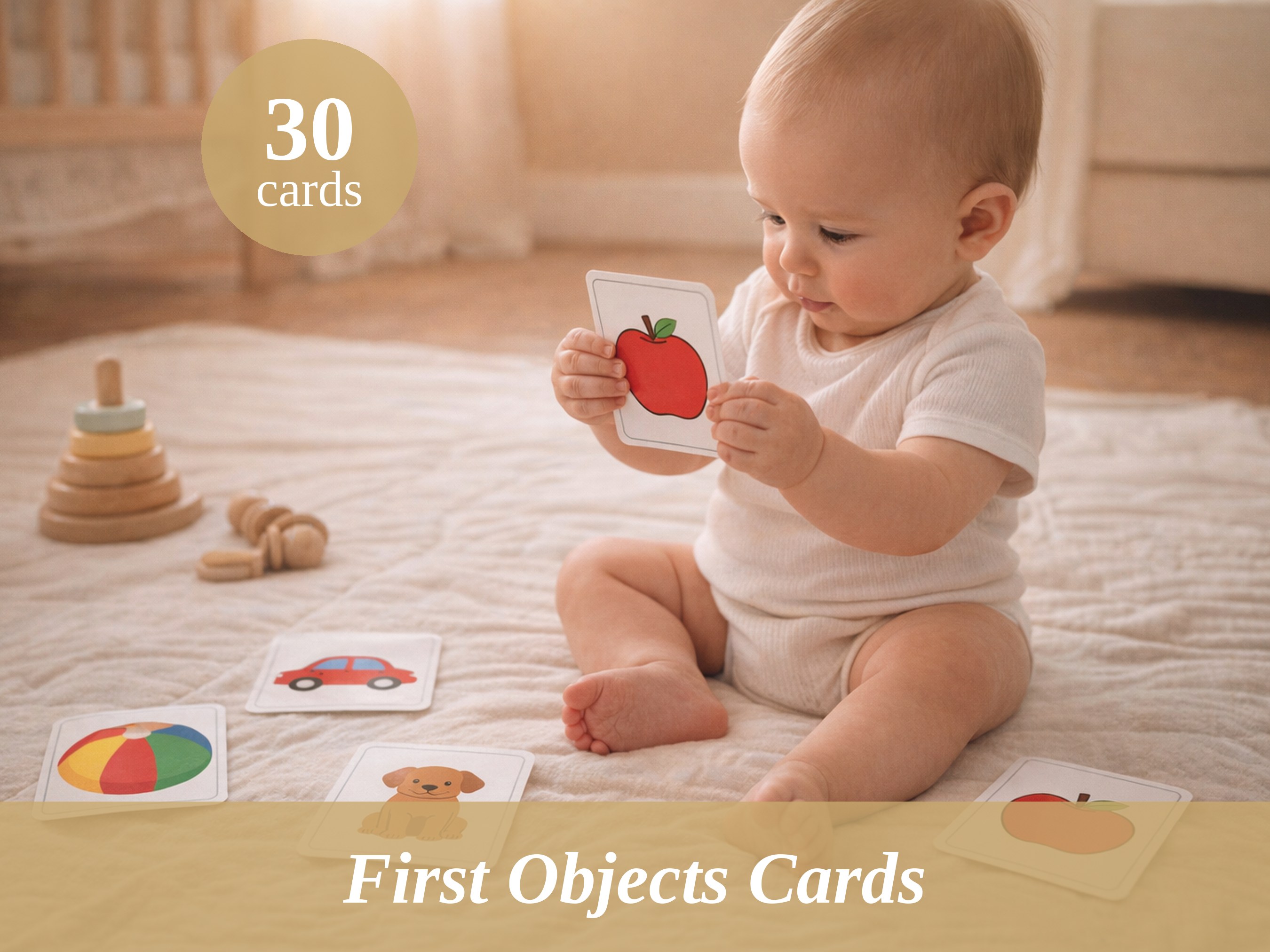
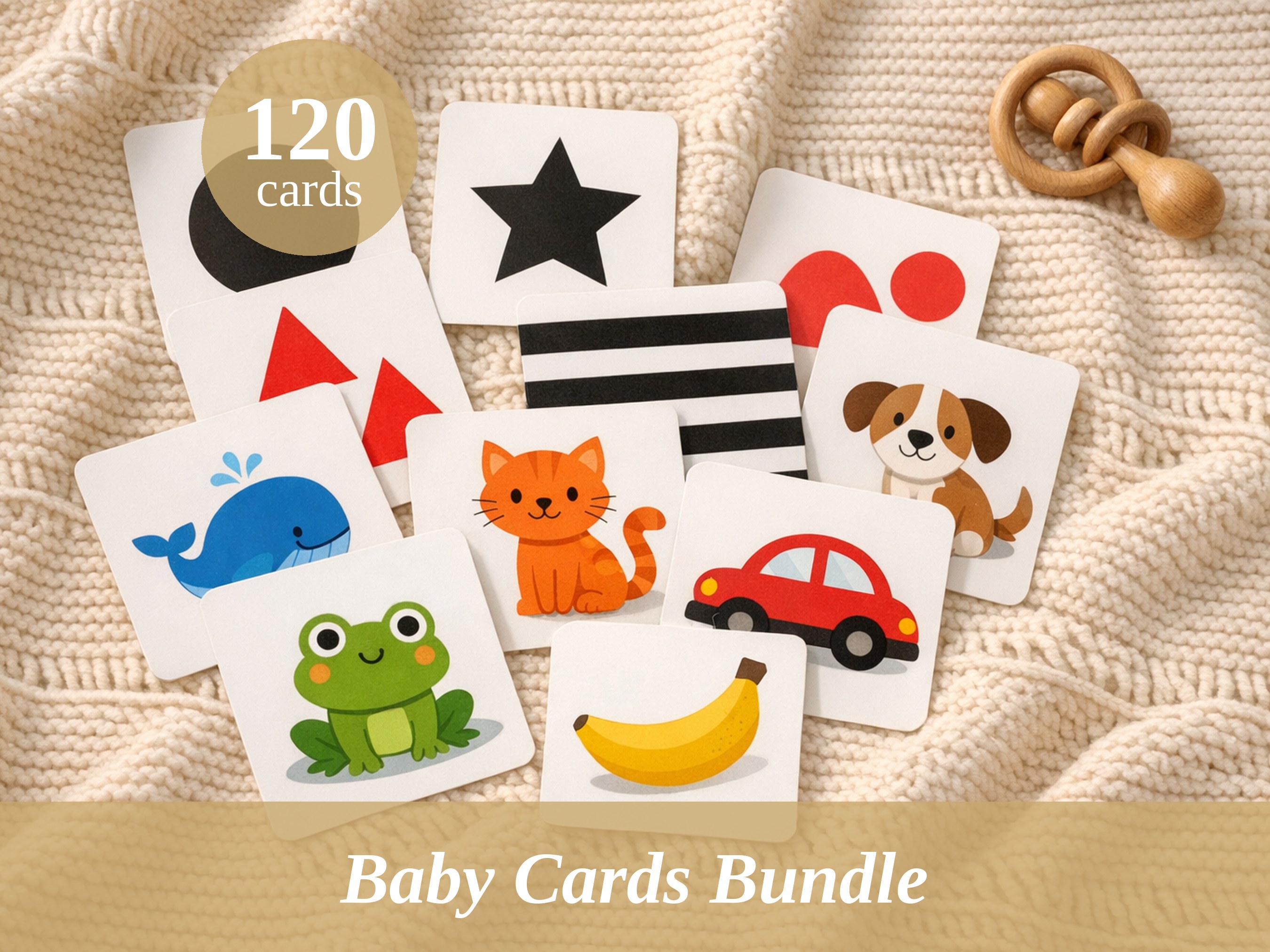
If you have ever wondered whether your newborn can actually see you, the answer is yes — just not clearly, not far away, and not in full color yet. In the first weeks, babies see best at roughly 8 to 12 inches. Color starts emerging gradually — red appears first, then other primaries follow over the coming months (American Optometric Association; HealthyChildren.org, American Academy of Pediatrics).
Core insight. Both visual clarity and color perception develop gradually. A few calm moments of looking, holding, and simple contrast are already enough to support it.
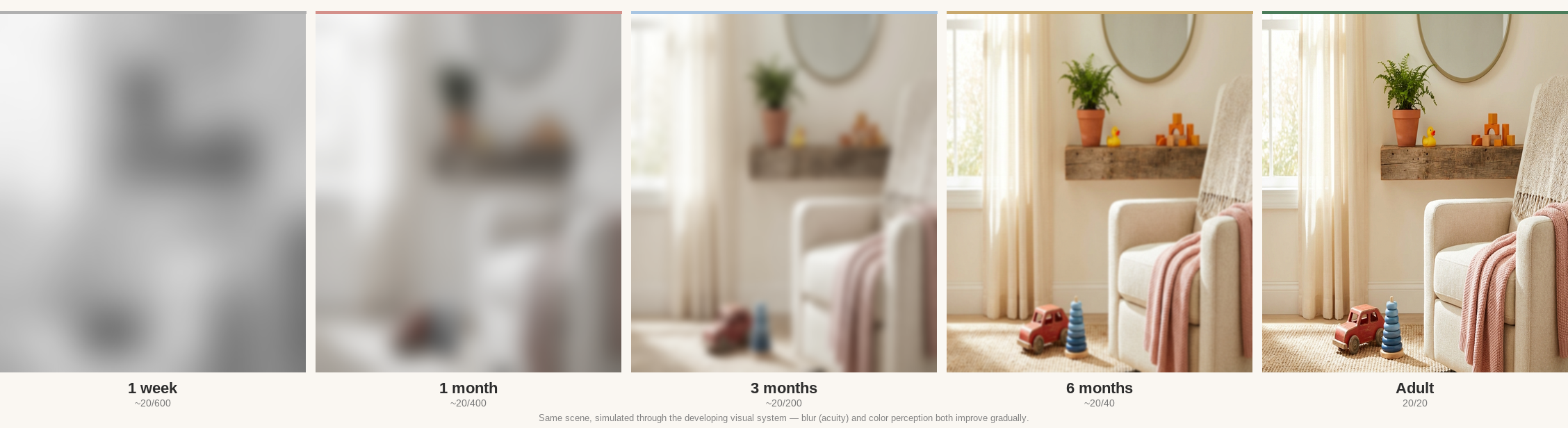
At 1 week
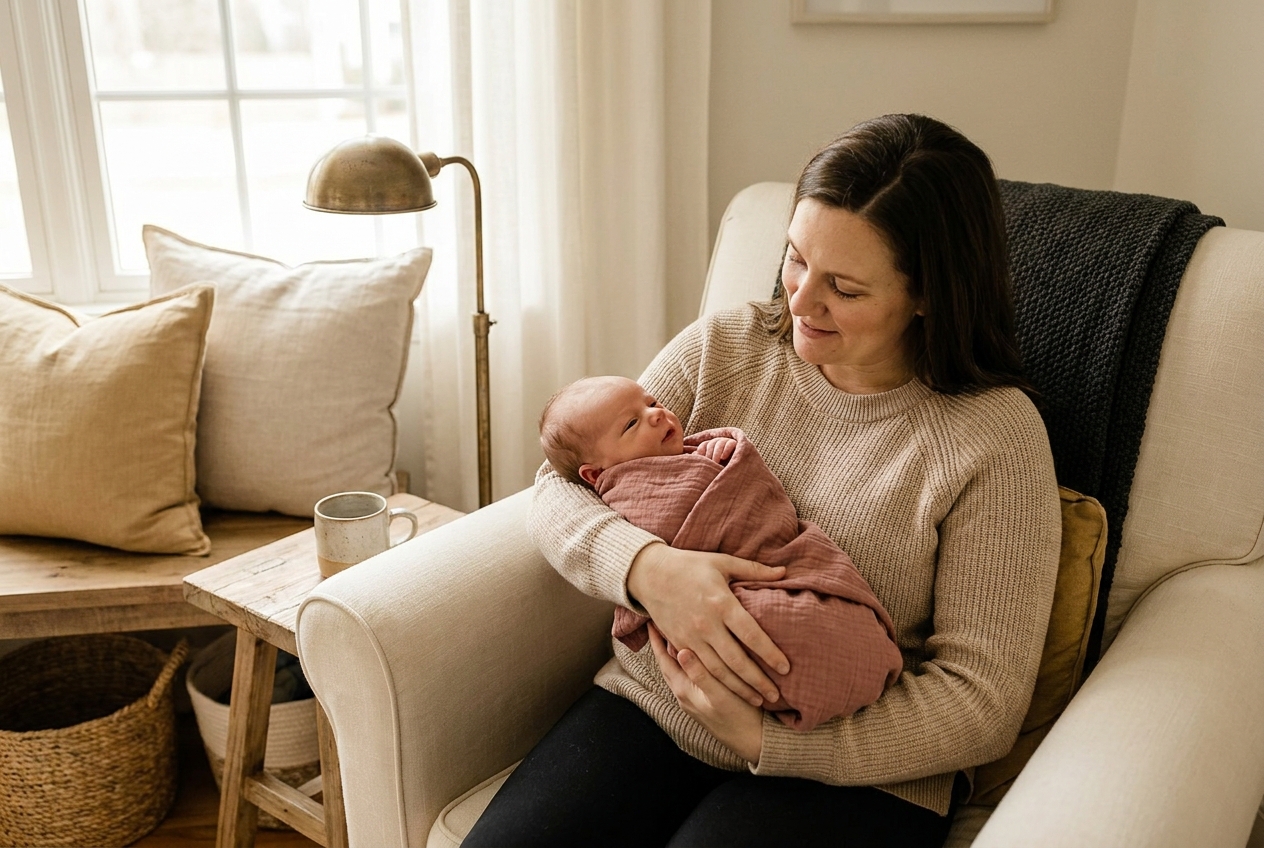
Vision is very blurry and nearly monochromatic — babies see best at 8–12 inches, drawn to strong contrast (dark hair against light skin, a window frame) more than color or detail (American Optometric Association). Short bursts of looking, not steady eye contact.
At 1 month

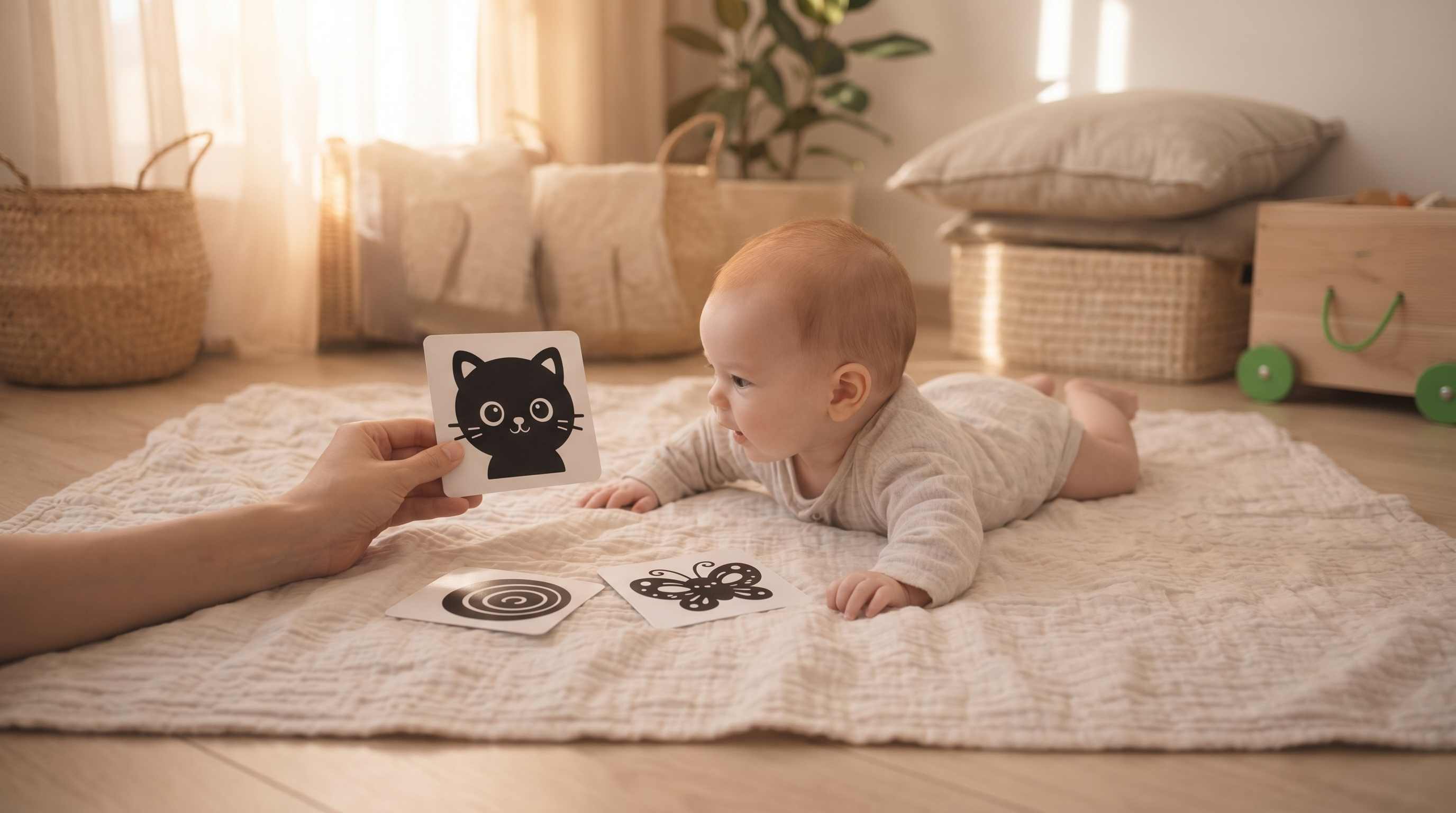
Looks get a little longer, and red is the first color babies begin to distinguish — which is why bold contrast cards stand out at this age. Some babies start watching your mouth or eyes, and you may see the first hints of tracking if you move slowly (HealthyChildren.org, American Academy of Pediatrics). Around 2–3 months, as the red channel strengthens, black, white and red cards are a natural next step.
Around 3 months
Tracking usually becomes smoother, and babies are more visually engaged. Color vision is developing, so brighter, simpler toys start to compete with black and white (American Optometric Association). Even ordinary life — hands, curtains, a rattle — is plenty of input. By 4–6 months, the full primary palette is coming online; bold colour cards lean into that biology rather than outpace it.
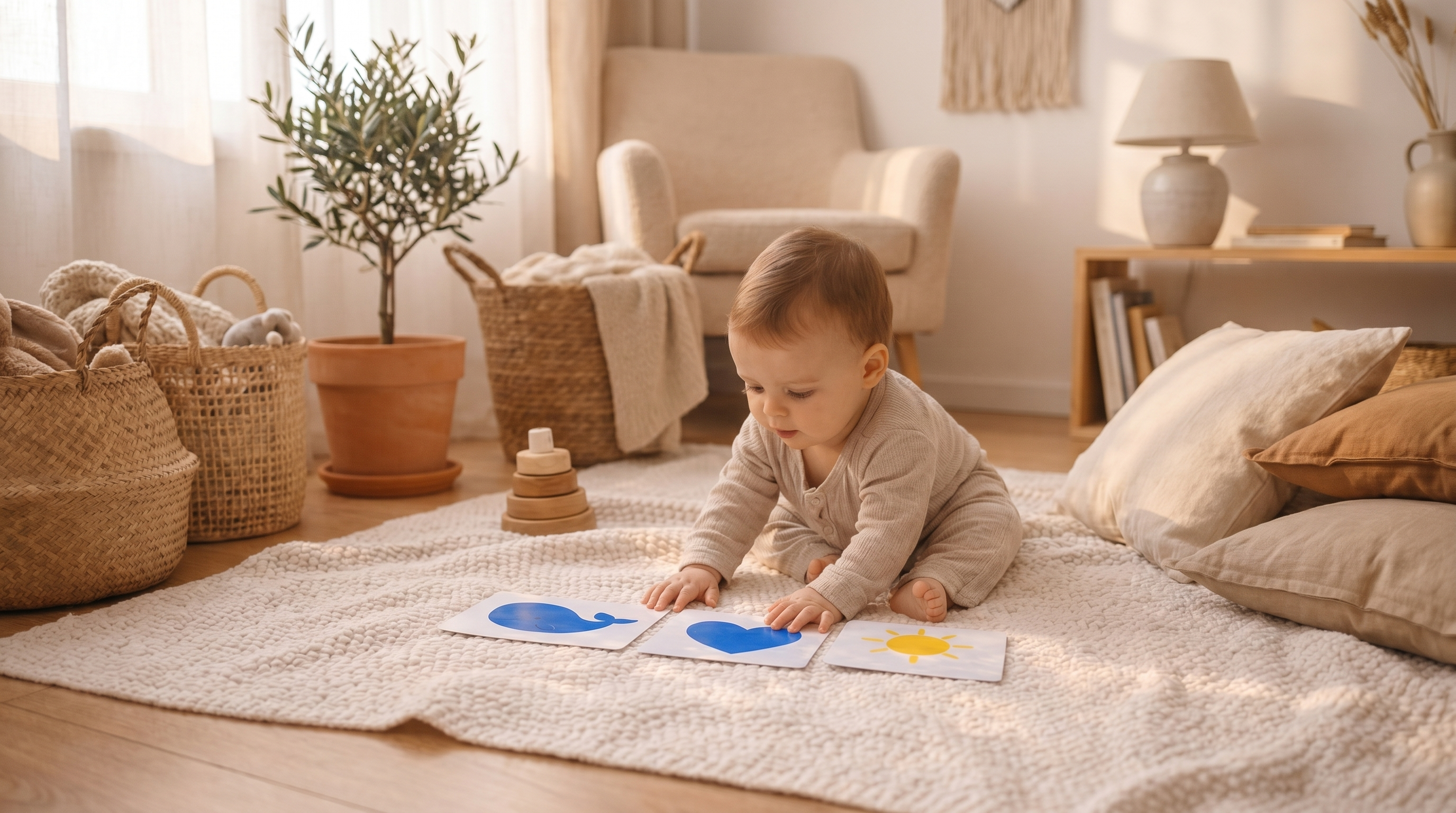
By 4 months, infants can discriminate colour pairs just 5–10 nanometres apart — a sensitivity that appears suddenly, not gradually (Teller et al., 1986).
Around 6 months

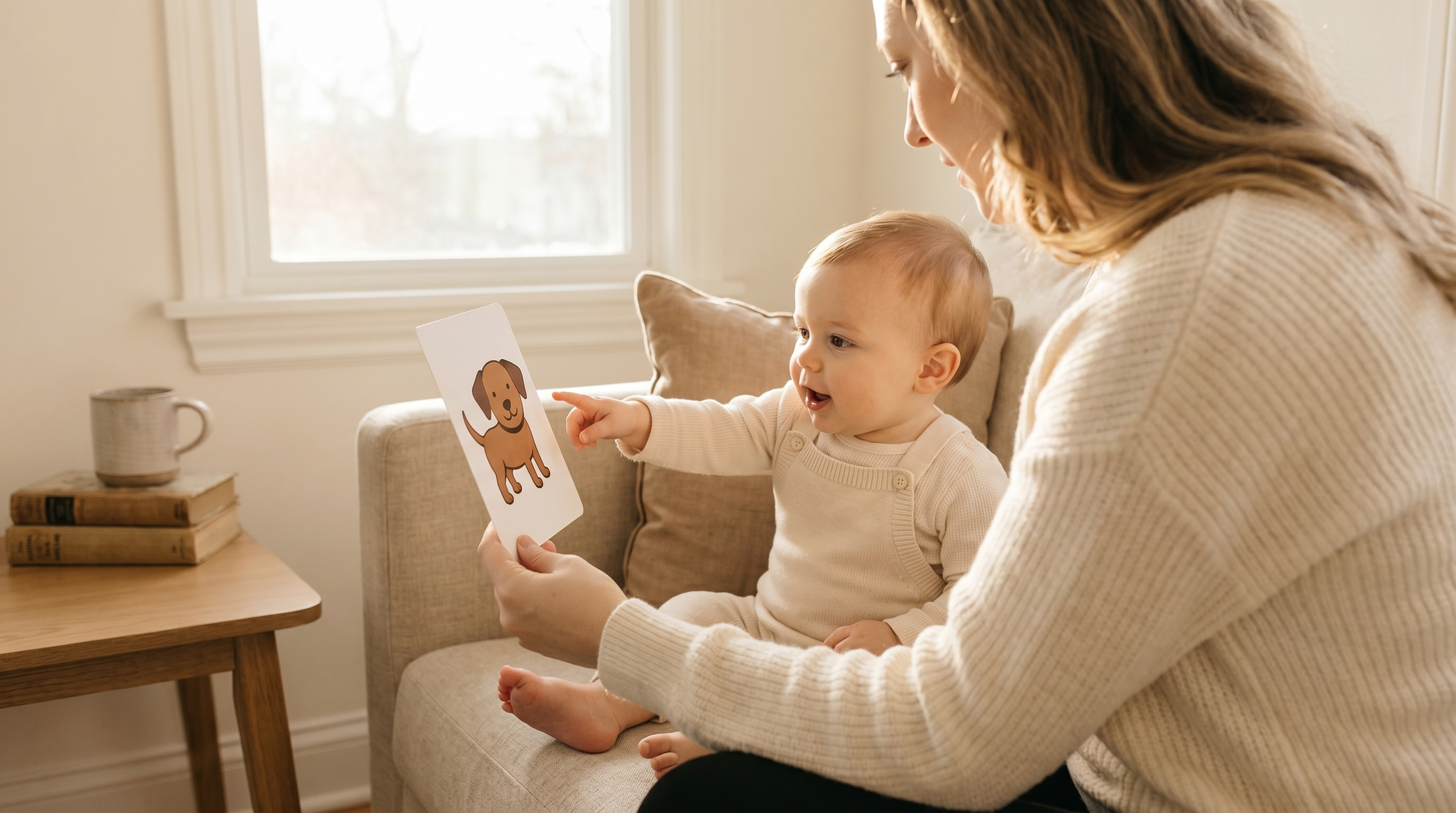
Distance vision and depth perception have improved, so babies notice people and objects from farther away (HealthyChildren.org, American Academy of Pediatrics). You will see more reaching, grabbing, and room-scale curiosity. Visual development is now blending into movement and play — and from around 9 months, babies start linking images to words. First-object cards are made for that window: one image, one word aloud, one tiny neural bridge.
Three ways to support it

Face time
Let your baby take in your face during feeds, diaper changes, and quiet couch moments. It is exactly what early vision is built for.

Slow tracking
Hold your face or a simple object at 8–12 inches and move it gently side to side. A few seconds counts — no formal "session" required.

High contrast
A black-and-white card or a bold muslin gives baby something clear to notice when everything else still looks fuzzy.
What you can skip. No need for flashing gadgets, back-to-back activities, or a packed schedule. Calm everyday interaction is already development-friendly for most babies.
 The four stages — each set designed for the visual window your baby is in.
| Stage | Age | What they see | Cards |
|---|---|---|---|
| A | 0–2m | High-contrast black & white | Baby Contrast Cards |
| B | 2–4m | +Red wavelength, first colour | Black, White & Red Cards |
| C | 4–6m | Full primary palette arriving | High Contrast Colour Cards |
| D | 6–12m | Objects, words, depth | First Objects Cards |
When to check in
Most variation in these weeks is normal. Still, check in with your pediatrician if your baby does not seem to notice light or faces, is not following objects by 3–4 months, has eyes that wander constantly past the first couple of months, or you notice redness, cloudiness, or unusual discharge (HealthyChildren.org, American Academy of Pediatrics; American Optometric Association).
A gentle takeaway
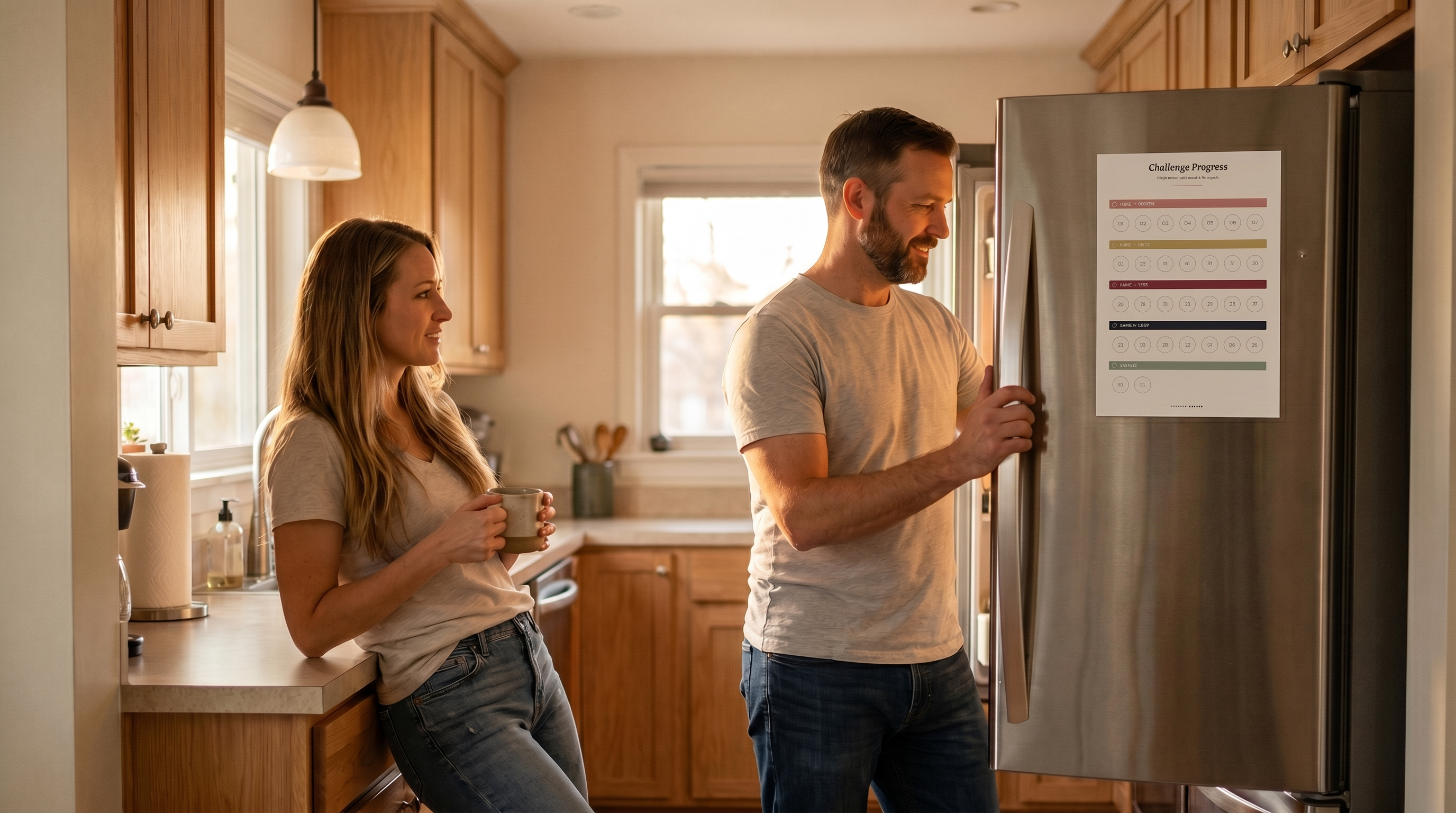
Your baby's vision is not meant to switch on all at once. It unfolds gradually, and the basics matter most: your face, a close cuddle, a little contrast. For one simple tool per stage, the Complete Visual Development Bundle has the whole first year in a single download.
Related reading
- Montessori-Inspired Toddler Activities at Home (12–36 months) — when your baby becomes a toddler
- The Science of Family Dinners — later, at the dinner table
Sources
- American Optometric Association. Infant Vision: Birth to 24 Months of Age. aoa.org.
- HealthyChildren.org, American Academy of Pediatrics. Visual Development in Infants. healthychildren.org.
- Teller, D. Y., Peeples, D. R., & Sekel, M. Discrimination of chromatic from white light by two-month-old human infants. Vision Research, 18(1), 41–48 (1978).
- Teller, D. Y. Teller Acuity Cards handbook. Vistech Consultants (1986).